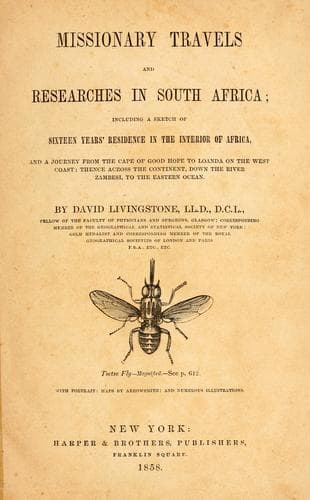
Missionary Travels and Researches in South AfricaLivingstone, David
Religion
Missionary Travels and Researches in South Africa
Livingstone, David
Missions -- South Africa; South Africa -- Description and travel
I sometimes felt annoyed at the low estimation in which some of my
hunting friends were held; for, believing that the chase is eminently
conducive to the formation of a brave and noble character, and that the
contest with wild beasts is well adapted for fostering that coolness
in emergencies, and active presence of mind, which we all admire, I
was naturally anxious that a higher estimate of my countrymen should be
formed in the native mind. "Have these hunters, who come so far and
work so hard, no meat at home?"--"Why, these men are rich, and could
slaughter oxen every day of their lives."--"And yet they come here, and
endure so much thirst for the sake of this dry meat, none of which is
equal to beef?"--"Yes, it is for the sake of play besides" (the idea of
sport not being in the language). This produces a laugh, as much as to
say, "Ah! you know better;" or, "Your friends are fools." When they can
get a man to kill large quantities of game for them, whatever HE may
think of himself or of his achievements, THEY pride themselves in having
adroitly turned to good account the folly of an itinerant butcher.
The water having at last flowed into the wells we had dug in sufficient
quantity to allow a good drink to all our cattle, we departed from
Serotli in the afternoon; but as the sun, even in winter, which it now
was, is always very powerful by day, the wagons were dragged but slowly
through the deep, heavy sand, and we advanced only six miles before
sunset. We could only travel in the mornings and evenings, as a single
day in the hot sun and heavy sand would have knocked up the oxen. Next
day we passed Pepacheu (white tufa), a hollow lined with tufa, in which
water sometimes stands, but it was now dry; and at night our trocheamer*
showed that we had made but twenty-five miles from Serotli.
* This is an instrument which, when fastened on the wagon-wheel,
records the number of revolutions made. By multiplying this number
by the circumference of the wheel, the actual distance traveled over
is at once ascertained.
Public-domain text, read in full here on John Shaqi.
Reviews
Reviews
No reviews yet
Be the first to share your thoughts on this work.
Elsewhere in the archive
Join the Discussion
Join the discussion
Sign in to leave a comment or review.
Sign InorCreate an account