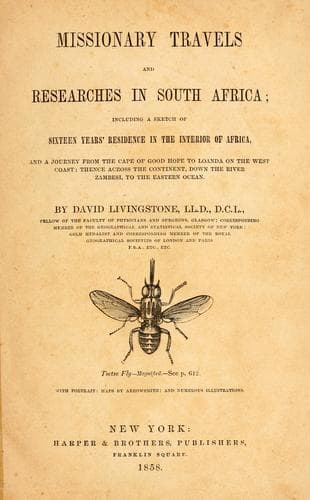
Missionary Travels and Researches in South AfricaLivingstone, David
Religion
Missionary Travels and Researches in South Africa
Livingstone, David
Missions -- South Africa; South Africa -- Description and travel
After breakfast, some of the men, who had gone forward on a little path
with some footprints of water-loving animals upon it, returned with the
joyful tidings of "metse", water, exhibiting the mud on their knees in
confirmation of the news being true. It does one's heart good to see the
thirsty oxen rush into a pool of delicious rain-water, as this was. In
they dash until the water is deep enough to be nearly level with their
throat, and then they stand drawing slowly in the long, refreshing
mouthfuls, until their formerly collapsed sides distend as if they would
burst. So much do they imbibe, that a sudden jerk, when they come out on
the bank, makes some of the water run out again from their mouths; but,
as they have been days without food too, they very soon commence to
graze, and of grass there is always abundance every where. This pool was
called Mathuluani; and thankful we were to have obtained so welcome a
supply of water.
After giving the cattle a rest at this spot, we proceeded down the dry
bed of the River Mokoko. The name refers to the water-bearing stratum
before alluded to; and in this ancient bed it bears enough of water
to admit of permanent wells in several parts of it. We had now the
assurance from Ramotobi that we should suffer no more from thirst. Twice
we found rain-water in the Mokoko before we reached Mokokonyani, where
the water, generally below ground elsewhere, comes to the surface in a
bed of tufa. The adjacent country is all covered with low, thorny scrub,
with grass, and here and there clumps of the "wait-a-bit thorn", or
'Acacia detinens'. At Lotlakani (a little reed), another spring three
miles farther down, we met with the first Palmyra trees which we had
seen in South Africa; they were twenty-six in number.
The ancient Mokoko must have been joined by other rivers below this, for
it becomes very broad, and spreads out into a large lake, of which the
lake we were now in search of formed but a very small part. We observed
that, wherever an ant-eater had made his hole, shells were thrown out
with the earth, identical with those now alive in the lake.
Public-domain text, read in full here on John Shaqi.
Reviews
Reviews
No reviews yet
Be the first to share your thoughts on this work.
Elsewhere in the archive
Join the Discussion
Join the discussion
Sign in to leave a comment or review.
Sign InorCreate an account