Missionary Travels and Researches in South AfricaLivingstone, David
Religion
Missionary Travels and Researches in South Africa
Livingstone, David
Missions -- South Africa; South Africa -- Description and travel
Next day we came to a village of Banajoa, a tribe which extends far to
the eastward. They were living on the borders of a marsh in which the
Mahabe terminates. They had lost their crop of corn ('Holcus sorghum'),
and now subsisted almost entirely on the root called "tsitla", a kind of
aroidoea, which contains a very large quantity of sweet-tasted starch.
When dried, pounded into meal, and allowed to ferment, it forms a not
unpleasant article of food. The women shave all the hair off their
heads, and seem darker than the Bechuanas. Their huts were built on
poles, and a fire is made beneath by night, in order that the smoke may
drive away the mosquitoes, which abound on the Mababe and Tamunak'le
more than in any other part of the country. The head man of this
village, Majane, seemed a little wanting in ability, but had had wit
enough to promote a younger member of the family to the office. This
person, the most like the ugly negro of the tobacconists' shops I ever
saw, was called Moroa Majane, or son of Majane, and proved an active
guide across the River Sonta, and to the banks of the Chobe, in the
country of Sebituane. We had come through another tsetse district
by night, and at once passed our cattle over to the northern bank to
preserve them from its ravages.
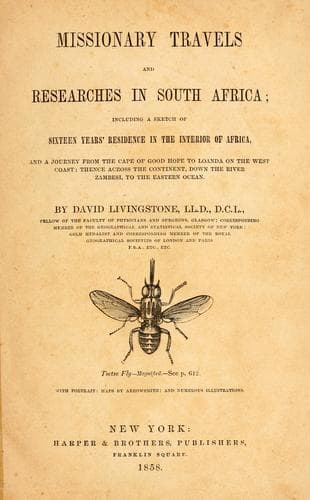
A few remarks on the Tsetse, or 'Glossina morsitans', may here be
appropriate. It is not much larger than the common house-fly, and is
nearly of the same brown color as the common honey-bee; the after part
of the body has three or four yellow bars across it; the wings project
beyond this part considerably, and it is remarkably alert, avoiding
most dexterously all attempts to capture it with the hand at common
temperatures; in the cool of the mornings and evenings it is less agile.
Its peculiar buzz when once heard can never be forgotten by the traveler
whose means of locomotion are domestic animals; for it is well known
that the bite of this poisonous insect is certain death to the ox,
horse, and dog. In this journey, though we were not aware of any great
number having at any time lighted on our cattle, we lost forty-three
fine oxen by its bite. We watched the animals carefully, and believe
that not a score of flies were ever upon them.
A most remarkable feature in the bite of the tsetse is its perfect
harmlessness in man and wild animals, and even calves, so long as they
continue to suck the cows. We never experienced the slightest injury
from them ourselves, personally, although we lived two months in their
HABITAT, which was in this case as sharply defined as in many others,
for the south bank of the Chobe was infested by them, and the northern
bank, where our cattle were placed, only fifty yards distant, contained
not a single specimen. This was the more remarkable, as we often saw
natives carrying over raw meat to the opposite bank with many tsetse
settled upon it.
Public-domain text, read in full here on John Shaqi.
Reviews
Reviews
No reviews yet
Be the first to share your thoughts on this work.
Elsewhere in the archive
Join the Discussion
Join the discussion
Sign in to leave a comment or review.
Sign InorCreate an account