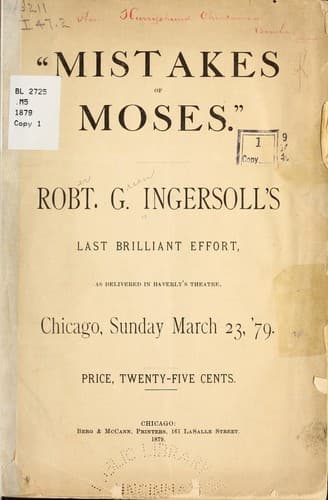
According to the bible, God selected the Jewish people through whom to
make known the great fact, that he was the only true and living God. For
this purpose, he appeared on several occasions to Moses--came down to
Sinai's top clothed in cloud and fire, and wrought a thousand miracles
for the preservation and education of the Jewish people. In their
presence he opened the waters of the sea. For them he caused bread to
rain from heaven. To quench their thirst, water leaped from the dry and
barren rock. Their enemies were miraculously destroyed; and for forty
years, at least, this God took upon himself the government of the Jews.
But, after all this, many of the people had less confidence in him
than in gods of wood and stone. In moments of trouble, in periods of
disaster, in the darkness of doubt, in the hunger and thirst of famine,
instead of asking this God for aid, they turned and sought the help of
senseless things. This God, with all his power and wisdom, could not
even convince a few wandering and wretched savages that he was more
potent than the idols of Egypt. This God was not willing that the Jews
should think and investigate for themselves. For heresy, the penalty
was death. Where this God reigned, intellectual liberty was unknown. He
appealed only to brute force; he collected taxes by threatening
plagues; he demanded worship on pain of sword and fire; acting as spy,
inquisitor, judge and executioner.
In the thirteenth chapter of Deuteronomy, we have the ideas of God as to
mental freedom. "If thy brother, the son of thy mother, or thy son, or
the wife of thy bosom, or thy friend which is as thine own soul, entice
thee secretly, saying, Let us go and serve other gods, which thou hast
not known, thou nor thy fathers; _namely_ of the gods of the people
which are around about you, nigh unto thee, or far off from thee, from
the one end of the earth even unto the other end of the earth, Thou
shalt not consent unto him, nor hearken unto him, neither shall thine
eye pity him, neither shalt thou spare him, neither shalt thou conceal
him. But thou shalt surely kill him; thine hand shall be first upon him
to put him to death, and afterward the hand of all the people. And thou
shalt stone him with stones that he die."
Public-domain text, read in full here on John Shaqi.
Reviews
Reviews
No reviews yet
Be the first to share your thoughts on this work.
Elsewhere in the archive
Join the Discussion
Join the discussion
Sign in to leave a comment or review.
Sign InorCreate an account