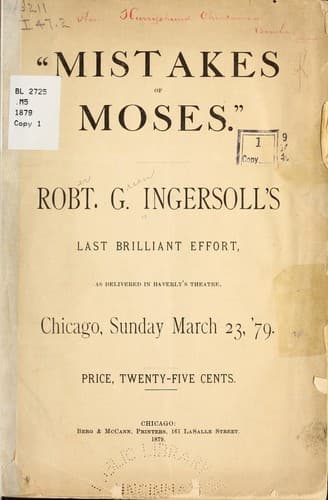
In the Old Testament no one is told to reason with a heretic, and not
one word is said about relying upon argument, upon education, nor upon
intellectual development--nothing except simple brute force. Is there
to-day a christian who will say that four thousand years ago, it was
the duty of a husband to kill his wife if she differed with him upon
the subject of religion? Is there one who will now say that, under such
circumstances, the wife ought to have been killed? Why should God be so
jealous of the wooden idols of the heathen? Could he not compete with
Baal? Was he envious of the success of the Egyptian magicians? Was it
not possible for him to make such a convincing display of his power as
to silence forever the voice of unbelief? Did this God have to resort to
force to make converts? Was he so ignorant of the structure of the human
mind as to believe all honest doubt a crime? If he wished to do away
with the idolatry of the Canaanites, why did he not appear to them? Why
did he not give them the tables of the law? Why did he only make known
his will to a few wandering savages in the desert of Sinai? Will some
theologian have the kindness to answer these questions? Will some
minister, who now believes in religious liberty, and eloquently
denounces the intolerance of Catholicism, explain these things; will he
tell us why he worships an intolerant God? Is a god who will burn a soul
forever in another world, better than a christian who burns the body for
a few hours in this? Is there no intellectual liberty in heaven? Do the
angels all discuss questions on the same side? Are all the investigators
in perdition? Will the penitent thief, winged and crowned, laugh at the
honest folks in hell? Will the agony of the damned increase or decrease
the happiness of God? Will there be, in the universe, an eternal _auto
da fe?_
XXIX. CONCLUSION
If the Pentateuch is not inspired in its astronomy, geology, geography,
history or philosophy, if it is not inspired concerning slavery,
polygamy, war, law, religious or political liberty, or the rights of
men, women and children, what is it inspired in, or about? The unity
of God?--that was believed long before Moses was born. Special
providence?--that has been the doctrine of ignorance in all ages.
The rights of property?--theft was always a crime. The sacrifice of
animals?--that was a custom thousands of years before a Jew existed.
The sacredness of life?--there have always been laws against murder.
The wickedness of perjury?--truthfulness has always been a virtue.
The beauty of chastity?--the Pentateuch does not teach it. Thou shalt
worship no other God?--that has been the burden of all religions.
Public-domain text, read in full here on John Shaqi.
Reviews
Reviews
No reviews yet
Be the first to share your thoughts on this work.
Elsewhere in the archive
Join the Discussion
Join the discussion
Sign in to leave a comment or review.
Sign InorCreate an account