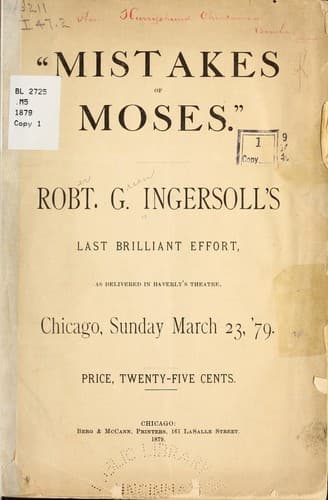
Let us admit what we know to be true; that Moses was mistaken about a
thousand things; that the story of creation is not true; that the garden
of Eden is a myth; that the serpent and the tree of knowledge, and the
fall of man are but fragments of old mythologies lost and dead; that
woman was not made out of a rib; that serpents never had the power of
speech; that the sons of God did not marry the daughters of men; that
the story of the flood and ark is not exactly true; that the tower of
Babel is a mistake; that the confusion of tongues is a childish thing;
that the origin of the rainbow is a foolish fancy; that Methuselah did
not live nine hundred and sixty-nine years; that Enoch did not leave
this world, taking with him his flesh and bones; that the story of Sodom
and Gomorrah is somewhat improbable; that burning brimstone never fell
like rain; that Lot's wife was not changed into chloride of sodium; that
Jacob did not, in fact, put his hip out of joint wrestling with God;
that the history of Tamar might just as well have been left out; that a
belief in Pharaoh's dreams is not essential to salvation; that it makes
but little difference whether the rod of Aaron was changed to a serpent
or not; that of all the wonders said to have been performed in Egypt,
the greatest is, that anybody ever believed the absurd account; that
God did not torment the innocent cattle on account of the sins of their
owners; that he did not kill the first born of the poor maid behind
the mill because of Pharaoh's crimes; that flies and frogs were not
ministers of God's wrath; that lice and locusts were not the executors
of his will; that seventy people did not, in two hundred and fifteen
years, increase to three million; that three priests could not eat
six hundred pigeons in a day; that gazing at a brass serpent could not
extract poison from the blood; that God did not go in partnership with
hornets; that he did not murder people simply because they asked for
something to eat; that he did not declare the making of hair oil
and ointment an offence to be punished with death; that he did not
miraculously preserve cloth and leather; that he was not afraid of wild
beasts; that he did not punish heresy with sword and fire; that he was
not jealous, revengeful, and unjust; that he knew all about the sun,
moon, and stars; that he did not threaten to kill people for eating the
fat of an ox; that he never told Aaron to draw cuts to see which of two
goats should be killed; that he never objected to clothes made of woolen
mixed with linen; that if he objected to dwarfs, people with flat noses
and too many fingers, he ought not to have created such folks; that
he did not demand human sacrifices as set forth in the last chapter
of Leviticus; that he did not object to the raising of horses; that he
never commanded widows to spit in the faces of their brothers-in-law;
that several contradictory accounts of the same transaction cannot all
Public-domain text, read in full here on John Shaqi.
Reviews
Reviews
No reviews yet
Be the first to share your thoughts on this work.
Elsewhere in the archive
Join the Discussion
Join the discussion
Sign in to leave a comment or review.
Sign InorCreate an account