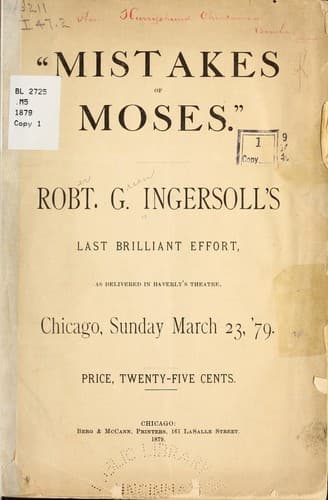
Every foolish and immodest thing should be expunged from the bible.
Let us keep the good. Let us preserve every great and splendid thought,
every wise and prudent maxim, every just law, every elevated idea, and
every word calculated to make man nobler and purer, and let us have
the courage to throw the rest away. The souls of children should not
be stained and soiled. The charming instincts of youth should not be
corrupted and defiled. The girls and boys should not be taught that
unclean words were uttered by "inspired" lips. Teach them that these
words were born of savagery and lust. Teach them that the unclean is the
unholy, and that only the pure is sacred.
XXI. THE HEBREWS
After language had been confounded and the people scattered, there
appeared in the land of Canaan a tribe of Hebrews ruled by a chief or
sheik called Abraham. They had a few cattle, lived in tents, practiced
polygamy, wandered from place to place, and were the only folks in the
whole world to whom God paid the slightest attention. At this time
there were hundreds of cities in India filled with temples and palaces;
millions of Egyptians worshiped Isis and Osiris, and had covered their
land with marvelous monuments of industry, power and skill. But these
civilizations were entirely neglected by the Deity, his whole attention
being taken up with Abraham and his family.
It seems, from the account, that God and Abraham were intimately
acquainted, and conversed frequently upon a great variety of subjects.
By the twelfth chapter of Genesis it appears that he made the following
promises to Abraham. "I will make of thee a great nation, and I will
bless thee, and make thy name great: and thou shalt be a blessing. And I
will bless them that bless thee, and curse him that curseth thee."
After receiving this communication from the Almighty, Abraham went into
the land of Canaan, and again God appeared to him and told him to take
a heifer three years old, a goat of the same age, a sheep of equal
antiquity, a turtle dove and a young pigeon. Whereupon Abraham killed
the animals "and divided them in the midst, and laid each piece one
against another." And it came to pass that when the sun went down and
it was dark, behold a smoking furnace and a burning lamp that passed
between the raw and bleeding meat. The killing of these animals was
a preparation for receiving a visit from God. Should an American
missionary in Central Africa find a negro chief surrounded by
a butchered heifer, a goat and a sheep, with which to receive a
communication from the infinite God, my opinion is, that the missionary
would regard the proceeding as the direct result of savagery. And if
the chief insisted that he had seen a smoking furnace and a burning
lamp going up and down between the pieces of meat, the missionary would
certainly conclude that the chief was not altogether right in his mind.
Public-domain text, read in full here on John Shaqi.
Reviews
Reviews
No reviews yet
Be the first to share your thoughts on this work.
Elsewhere in the archive
Join the Discussion
Join the discussion
Sign in to leave a comment or review.
Sign InorCreate an account