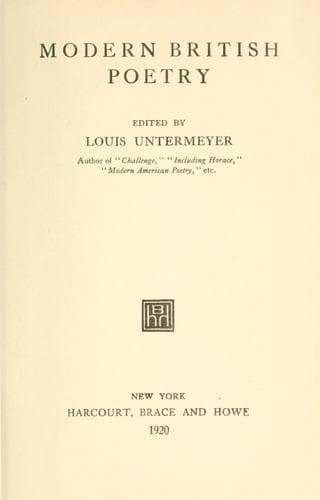
English poetry -- 19th century; English poetry -- 20th century
They cry unto the night their battle-name:
I moan in sleep when I hear afar their whirling laughter.
They cleave the gloom of dreams, a blinding flame,
Clanging, clanging upon the heart as upon an anvil.
They come shaking in triumph their long, green hair:
They come out of the sea and run shouting by the shore.
My heart, have you no wisdom thus to despair?
My love, my love, my love, why have you left me alone?
_J. C. Squire_
Jack Collings Squire was born April 2, 1884, at Plymouth, of Devonian
ancestry. He was educated at Blundell's and Cambridge University, and
became known first as a remarkably adroit parodist. His _Imaginary
Speeches_ (1912) and _Tricks of the Trade_ (1917) are amusing parodies
and, what is more, excellent criticism. He edited _The New Statesman_
for a while and founded _The London Mercury_ (a monthly of which he is
editor) in November, 1919. Under the pseudonym "Solomon Eagle" he
wrote a page of literary criticism every week for six years, many of
these papers being collected in his volume, _Books in General_ (1919).
His original poetry is intellectual but simple, sometimes metaphysical
and always interesting technically in its fluent and variable rhythms.
A collection of his best verse up to 1919 was published under the
title, _Poems: First Series_.
A HOUSE
Now very quietly, and rather mournfully,
In clouds of hyacinth the sun retires,
And all the stubble-fields that were so warm to him
Keep but in memory their borrowed fires.
And I, the traveller, break, still unsatisfied,
From that faint exquisite celestial strand,
And turn and see again the only dwelling-place
In this wide wilderness of darkening land.
The house, that house, O now what change has come to it.
Its crude red-brick facade, its roof of slate;
What imperceptible swift hand has given it
A new, a wonderful, a queenly state?
No hand has altered it, that parallelogram,
So inharmonious, so ill-arranged;
That hard blue roof in shape and colour's what it was;
No, it is not that any line has changed.
Only that loneliness is now accentuate
And, as the dusk unveils the heaven's deep cave,
This small world's feebleness fills me with awe again,
And all man's energies seem very brave.
And this mean edifice, which some dull architect
Built for an ignorant earth-turning hind,
Takes on the quality of that magnificent
Unshakable dauntlessness of human kind.
Darkness and stars will come, and long the night will be,
Yet imperturbable that house will rest,
Avoiding gallantly the stars' chill scrutiny,
Ignoring secrets in the midnight's breast.
Thunders may shudder it, and winds demoniac
May howl their menaces, and hail descend:
Yet it will bear with them, serenely, steadfastly,
Not even scornfully, and wait the end.
Public-domain text, read in full here on John Shaqi.
Reviews
Reviews
No reviews yet
Be the first to share your thoughts on this work.
Elsewhere in the archive
Join the Discussion
Join the discussion
Sign in to leave a comment or review.
Sign InorCreate an account