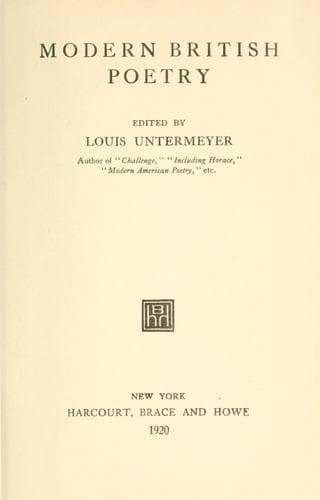
English poetry -- 19th century; English poetry -- 20th century
I have seen old ships sail like swans asleep
Beyond the village which men still call Tyre,
With leaden age o'ercargoed, dipping deep
For Famagusta and the hidden sun
That rings black Cyprus with a lake of fire;
And all those ships were certainly so old--
Who knows how oft with squat and noisy gun,
Questing brown slaves or Syrian oranges,
The pirate Genoese
Hell-raked them till they rolled
Blood, water, fruit and corpses up the hold.
But now through friendly seas they softly run,
Painted the mid-sea blue or shore-sea green,
Still patterned with the vine and grapes in gold.
But I have seen,
Pointing her shapely shadows from the dawn
And image tumbled on a rose-swept bay,
A drowsy ship of some yet older day;
And, wonder's breath indrawn,
Thought I--who knows--who knows--but in that same
(Fished up beyond Aeaea, patched up new
--Stern painted brighter blue--)
That talkative, bald-headed seaman came
(Twelve patient comrades sweating at the oar)
From Troy's doom-crimson shore,
And with great lies about his wooden horse
Set the crew laughing, and forgot his course.
It was so old a ship--who knows, who knows?
--And yet so beautiful, I watched in vain
To see the mast burst open with a rose,
And the whole deck put on its leaves again.
_D. H. Lawrence_
David Herbert Lawrence, born in 1885, is one of the most
psychologically intense of the modern poets. This intensity, ranging
from a febrile morbidity to an exalted and almost frenzied mysticism,
is seen even in his prose works--particularly in his short stories,
_The Prussian Officer_ (1917), his analytical _Sons and Lovers_
(1913), and the rhapsodic novel, _The Rainbow_ (1915).
As a poet he is often caught in the net of his own emotions; his
passion thickens his utterance and distorts his rhythms, which
sometimes seem purposely harsh and bitter-flavored. But within his
range he is as powerful as he is poignant. His most notable volumes of
poetry are _Amores_ (1916), _Look! We Have Come Through!_ (1918), and
_New Poems_ (1920).
PEOPLE
The great gold apples of light
Hang from the street's long bough
Dripping their light
On the faces that drift below,
On the faces that drift and blow
Down the night-time, out of sight
In the wind's sad sough.
The ripeness of these apples of night
Distilling over me
Makes sickening the white
Ghost-flux of faces that hie
Them endlessly, endlessly by
Without meaning or reason why
They ever should be.
PIANO
Softly, in the dusk, a woman is singing to me;
Taking me back down the vista of years, till I see
A child sitting under the piano, in the boom of the
tingling strings
And pressing the small, poised feet of a mother who
smiles as she sings.
Public-domain text, read in full here on John Shaqi.
Reviews
Reviews
No reviews yet
Be the first to share your thoughts on this work.
Elsewhere in the archive
Join the Discussion
Join the discussion
Sign in to leave a comment or review.
Sign InorCreate an account