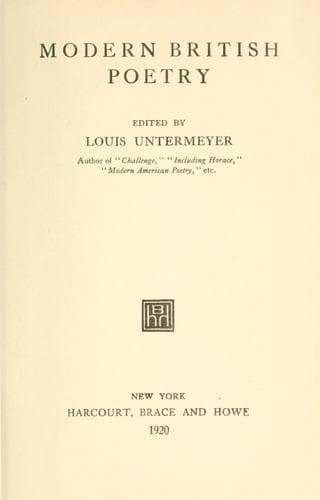
English poetry -- 19th century; English poetry -- 20th century
Only a starveling singer seeks
The stuff of songs among the Greeks.
Juno is old,
Jove's loves are cold;
Tales over-told.
By a new risen Attic stream
A mortal singer dreamed a dream.
Fixed he not Fancy's habitation,
Nor set in bonds Imagination.
There are new waters, and a new Humanity.
For all old myths give us the dream to be.
We are outwearied with Persephone;
Rather than her, we'll sing Reality.
SONG
I was so chill, and overworn, and sad,
To be a lady was the only joy I had.
I walked the street as silent as a mouse,
Buying fine clothes, and fittings for the house.
But since I saw my love
I wear a simple dress,
And happily I move
Forgetting weariness.
_Siegfried Sassoon_
Siegfried Loraine Sassoon, the poet whom Masefield hailed as "one of
England's most brilliant rising stars," was born September 8, 1886. He
was educated at Marlborough and Clare College, Cambridge, and was a
captain in the Royal Welsh Fusiliers. He fought three times in France,
once in Palestine, winning the Military Cross for bringing in wounded
on the battlefield.
His poetry divides itself sharply in two moods--the lyric and the
ironic. His early lilting poems were without significance or
individuality. But with _The Old Huntsman_ (1917) Sassoon found his
own idiom, and became one of the leading younger poets upon the
appearance of this striking volume. The first poem, a long monologue
evidently inspired by Masefield, gave little evidence of what was to
come. Immediately following it, however, came a series of war poems,
undisguised in their tragedy and bitterness. Every line of these
quivering stanzas bore the mark of a sensitive and outraged nature;
there was scarcely a phrase that did not protest against the
"glorification" and false glamour of war.
_Counter-Attack_ appeared in 1918. In this volume Sassoon turned
entirely from an ordered loveliness to the gigantic brutality of war.
At heart a lyric idealist, the bloody years intensified and twisted
his tenderness till what was stubborn and satiric in him forced its
way to the top. In _Counter-Attack_ Sassoon found his angry outlet.
Most of these poems are choked with passion; many of them are torn
out, roots and all, from the very core of an intense conviction; they
rush on, not so much because of the poet's art but almost in spite of
it. A suave utterance, a neatly-joined structure would be out of place
and even inexcusable in poems like "The Rear-Guard," "To Any Dead
Officer," "Does It Matter?"--verses that are composed of love, fever
and indignation.
Public-domain text, read in full here on John Shaqi.
Reviews
Reviews
No reviews yet
Be the first to share your thoughts on this work.
Elsewhere in the archive
Join the Discussion
Join the discussion
Sign in to leave a comment or review.
Sign InorCreate an account