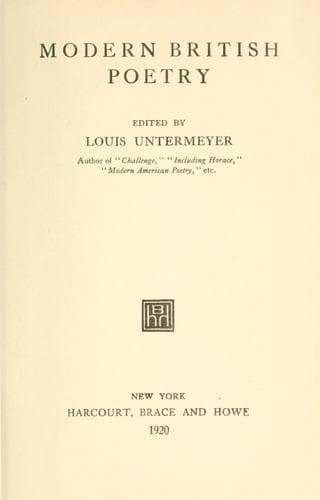
English poetry -- 19th century; English poetry -- 20th century
And think, this heart, all evil shed away,
A pulse in the eternal mind, no less
Gives somewhere back the thoughts by England given;
Her sights and sounds; dreams happy as her day;
And laughter, learnt of friends; and gentleness,
In hearts at peace, under an English heaven.
FOOTNOTES:
[19] From _The Collected Poems of Rupert Brooke_. Copyright, 1915, by
John Lane Company and reprinted by permission.
[20] From _The Collected Poems of Rupert Brooke_. Copyright, 1915, by
John Lane Company and reprinted by permission.
[21] From _The Collected Poems of Rupert Brooke_. Copyright, 1915, by
John Lane Company and reprinted by permission.
_Winifred M. Letts_
Winifred M. Letts was born in Ireland in 1887, and her early work
concerned itself almost entirely with the humor and pathos found in
her immediate surroundings. Her _Songs from Leinster_ (1913) is her
most characteristic collection; a volume full of the poetry of simple
people and humble souls. Although she has called herself "a back-door
sort of bard," she is particularly effective in the old ballad measure
and in her quaint portrayal of Irish peasants rather than of Gaelic
kings and pagan heroes. She has also written three novels, five books
for children, a later volume of _Poems of the War_ and, during the
conflict, served as a nurse at various base hospitals.
GRANDEUR
Poor Mary Byrne is dead,
An' all the world may see
Where she lies upon her bed
Just as fine as quality.
She lies there still and white,
With candles either hand
That'll guard her through the night:
Sure she never was so grand.
She holds her rosary,
Her hands clasped on her breast.
Just as dacint as can be
In the habit she's been dressed.
In life her hands were red
With every sort of toil,
But they're white now she is dead,
An' they've sorra mark of soil.
The neighbours come and go,
They kneel to say a prayer,
I wish herself could know
Of the way she's lyin' there.
It was work from morn till night,
And hard she earned her bread:
But I'm thinking she's a right
To be aisy now she's dead.
When other girls were gay,
At wedding or at fair,
She'd be toiling all the day,
Not a minyit could she spare.
An' no one missed her face,
Or sought her in a crowd,
But to-day they throng the place
Just to see her in her shroud.
The creature in her life
Drew trouble with each breath;
She was just "poor Jim Byrne's wife"--
But she's lovely in her death.
I wish the dead could see
The splendour of a wake,
For it's proud herself would be
Of the keening that they make.
Och! little Mary Byrne,
You welcome every guest,
Is it now you take your turn
To be merry with the rest?
Public-domain text, read in full here on John Shaqi.
Reviews
Reviews
No reviews yet
Be the first to share your thoughts on this work.
Elsewhere in the archive
Join the Discussion
Join the discussion
Sign in to leave a comment or review.
Sign InorCreate an account