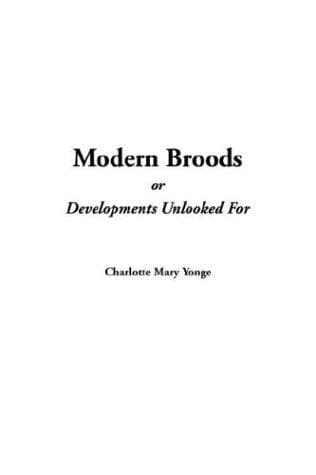
Modern Broods; Or, Developments Unlooked ForYonge, Charlotte M. (Charlotte Mary)
General
Modern Broods; Or, Developments Unlooked For
Yonge, Charlotte M. (Charlotte Mary)
Domestic fiction; England -- Social life and customs -- 19th century -- Fiction; English fiction
It was a strange retrospect, talked over by the two old friends in deep
thankfulness, yet humility over their own shortcomings and failures, and
no less strange were the recollections of the wild noisy insubordinate
schoolgirl whom the Bishop’s sister had failed to tame, and who had to
both seemed to live only on sensation, whether religious or secular, and
who had been one continual care and perplexity to each. By turns they
had thought that the full Church system acted as a hotbed on her peculiar
temperament, and at others they had thought it only an alternative to the
amusements of vanity and flirtation. Each had felt himself a failure
with regard to her, and had hoped for a fresh start from each crisis of
repentance, notably, from the death of Felix, only to be disappointed by
some fresh aberration.
However, in Queensland, her work had been noble, and thoroughly effective
in many cases; it had involved much self-denial and even danger, and
though these might agree with her native spirit of adventure, there had
likewise been not fitful, but steadily earnest devotion in her convent
life, as well as the tenderest reverent care of Mother Constance in a
long and painful decline, and therewith a steady cheerful influence which
had immensely assisted the growth of Fulbert’s character. For some years
past, Sister Angela had been not a care, but a trusty helper to the
Bishop; and the later trials and difficulties, especially the sore
rending of the tie with the being she had come to love with all the force
of her strong nature, had been borne in a manner that bore witness to the
subduing of that over-rebellious and vehement spirit.
And, as she said to Geraldine on the last evening as they bade
good-night, “This has been the very happiest time I ever spent here—yes,
happier than in those exultant days of new possession and liberty. Oh,
yes, all experiments, as it were, bold ventures, self-reproach and
failure, defiance and fun, and then—oh, the ache I would not confess, the
glory of being provoking, and, oh, the final anguish I brought on myself
and on you all; and I went on, when it began to wear away, still stifling
the sting which revived whenever I came home, and all was renewed!
Really, whenever I shammed it was only remorse. I don’t think that real
repentance, and the peace after it, began till those quiet days with dear
Mother Constance.”
“And is it peace now?”
“Yes, I think so. Even the parting with my child has not torn me up. I
can say it is well—far better than leaving her, far better, indeed! And
Felix is what he meant to be, my treasure, not my accuser. Oh, I am glad
to have been at home, and made it all up, to bear away—and leave with you
the sense of Peace.”
All who had loved and feared for her were very happy over her when all
joined in that farewell service on her own birthday, St. Michael and All
Angels’ Day.
Public-domain text, read in full here on John Shaqi.
Reviews
Reviews
No reviews yet
Be the first to share your thoughts on this work.
Elsewhere in the archive
Join the Discussion
Join the discussion
Sign in to leave a comment or review.
Sign InorCreate an account