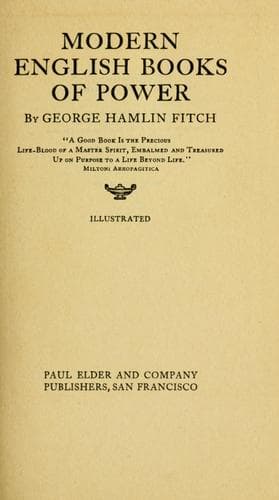
English literature -- 19th century -- History and criticism
No space is left here to mention in detail Ruskin's other works, but
_Unto This Last_, _The Stones of Venice_, _Sesame and Lilies_ and _The
Crown of Wild Olive_ may be commended as well worth careful reading.
Also _Preterita_ is alive with noble passages, such as the pen-picture
of the view from the Dale in the Alps, or of the Rhone below Geneva.
Read also Ruskin's description of Turner's "Slave Ship" or the
impressive passage on the mental slavery of the modern workman in the
sixth chapter of the second volume of _The Stones of Venice_. Read
these things and you will have no doubt of the genius of Ruskin or of
his command of the finest impassioned prose in the English language.
TENNYSON LEADS THE VICTORIAN WRITERS
THE POET WHO VOICED THE ASPIRATIONS OF HIS AGE--"LOCKSLEY
HALL," "IN MEMORIAM" AND "THE IDYLLS OF THE KING" AMONG HIS
BEST WORKS.
Of all the great English writers of the Victorian age it is probable
that the next century will give the foremost place to Tennyson. Better
than any other poet of his day, he stands as a type of the English
people in obedience to law, in strong religious faith, in splendid
imaginative force and in a certain unyielding cast of mind that made
him bide his time during the dark years when he was bitterly
criticized or coldly neglected. Tennyson had to the full the poet's
temperament, but he had also a superb physique, which carried him into
his eighty-fourth year. From a boy he was a lover of nature, and in
nearly every poem that he wrote are found many proofs of his close
observation in English woods and fields. Through a period of general
skepticism he kept unimpaired his strong faith in God and in
immortality that lends so much force to his best verse.
[Illustration: ALFRED, LORD TENNYSON AFTER AN ENGRAVING BY G.J.
STODART FROM A PHOTOGRAPH BY J. MAYALL]
Tennyson's genius found its natural expression in verse, and it is his
distinction that while he explored many realms of thought he was
always clear and always musical. Browning had more passion, but it was
the misfortune of the author of _The Ring and the Book_ that he could
not refrain from a cramped and obscure style of verse that makes much
of his work very hard reading. Many Browning societies have been
formed to study the works of the poet whom they are proud to call
master; but Tennyson needs no societies, as the man in the street and
the woman whose soul is troubled can understand every line he has
written. Nor is Tennyson lacking in passion, as any one may see by
reading _Locksley Hall_ or _Maud_.
Public-domain text, read in full here on John Shaqi.
Reviews
Reviews
No reviews yet
Be the first to share your thoughts on this work.
Join the Discussion
Join the discussion
Sign in to leave a comment or review.
Sign InorCreate an account