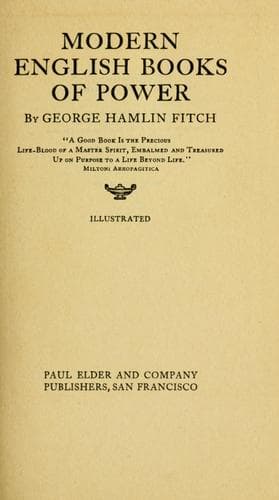
English literature -- 19th century -- History and criticism
Tennyson summed up in his poetry all the spiritual aspiration and the
eager search for knowledge of his time. He explored all domains of
thought, and he enriched his verse with the fruit of his studies. All
the great elemental forces are found in his poems: he is the laureate
of love and sorrow, of grief and aspiration. Throughout his verse runs
the great natural law that the man who is not pure in heart can never
see the glory of the poet's vision.
The purity of his own life was reflected in his verse, just as the mad
license and the furious self-indulgence of Byron are mirrored in _Don
Juan_, _Manfred_ and _Cain_. Even to extreme old age Tennyson
preserved that high poetic faculty which he manifested in early youth.
One of his latest poems, _Crossing the Bar_, is also one of the finest
in the language, breathing the old man's assurance of a life beyond
the grave and a reunion with the dear friend of his youth, whom he
mourned and immortalized in _In Memoriam_.
Alfred Tennyson had one of the finest lives in the roll of English
authors. He was born in 1809 and lived to 1892. He spent his early
years in one of the most beautiful parts of Lincolnshire. He enjoyed
the personal training of his father, a very accomplished clergyman,
and much of his boyhood and youth was spent in the open air. In this
way he absorbed that knowledge of birds and animals, trees and flowers
and all the aspects of nature which is reflected in his verse. As a
youth he experimented in many styles of verse, and when only eighteen
he issued, with his brother Charles, _Poems by Two Brothers_. The next
year he and Charles entered Trinity College, Cambridge. There they
received the greatest impulse toward culture in a society of
undergraduates known as the "Apostles." Its membership included
Thackeray, Trench, Spedding, Monckton Milnes and Alfred and Arthur
Henry Hallam, sons of the famous author of _The Middle Ages_.
In his second year at college Tennyson won the Chancellor's gold medal
with his prize poem, _Timbuctoo_, and in the following year he
published his first volume, _Poems, Chiefly Lyrical_. He left college
without a degree, and in 1833 he issued another volume of poems which
contained some of his best work--_The Lady of Shalott_, _The Lotos
Eaters_, _The Palace of Art_ and _A Dream of Fair Women_. Any one of
these poems if issued to-day would make the reputation of a poet, but
this book made little impression on the Victorian public which had
lost its taste for poetry and was devoted mainly to prose fiction. The
world has yet to catch the note of this master singer.
Public-domain text, read in full here on John Shaqi.
Reviews
Reviews
No reviews yet
Be the first to share your thoughts on this work.
Join the Discussion
Join the discussion
Sign in to leave a comment or review.
Sign InorCreate an account