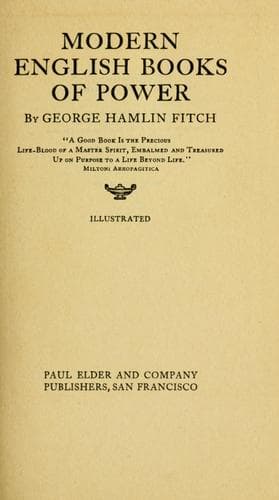
English literature -- 19th century -- History and criticism
Meredith was a singularly acute critic of the work of others, but when
he came to write himself he cast his thoughts in a style that has been
the despair of many admirers. In this he resembled Browning, who never
would write verse that was easy reading. Meredith's thought is usually
clear, yet his brilliant but erratic mind was impelled to clothe this
thought in the most bizarre garments. Literary paradox he loved; his
mind turned naturally to metaphor, and despite the protests of his
closest friends he continued to puzzle and exasperate the public. He
who could have written the greatest novels of his age merely wrote
stories which serve to illustrate his theories of life and conduct. No
man ever put more real thought into novels than he; none had a finer
eye for the beauties of nature or the development of character. But he
had no patience to develop his men and women in the clear, orthodox
way. He imagined that the ordinary reader could follow his lightning
flashes of illumination, his piling up of metaphor on metaphor, and
the result is that many are discouraged by his methods, just as nine
readers out of ten are wearied when they attempt to read Browning's
longer poems. His kinship to Browning is strong in style and in
method of thought, in his way of leaping from one conclusion to
another, in his elimination of all the usual small connecting words
and in his liberties with the language. He seemed to be writing for
himself, not for the general public, and he never took into account
the slower mental processes of those not endowed with his own vivid
imagination.
[Illustration: GEORGE MEREDITH WITH HIS DAUGHTER AND
GRANDCHILDREN--FROM A PHOTOGRAPH TAKEN SHORTLY BEFORE HIS DEATH]
Public-domain text, read in full here on John Shaqi.
Reviews
Reviews
No reviews yet
Be the first to share your thoughts on this work.
Elsewhere in the archive
Join the Discussion
Join the discussion
Sign in to leave a comment or review.
Sign InorCreate an account