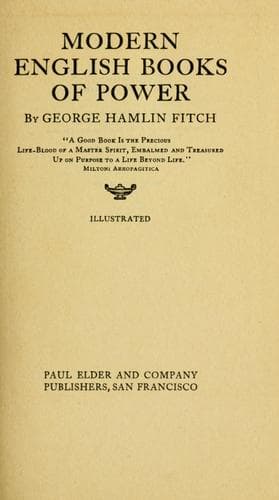
English literature -- 19th century -- History and criticism
Hardy's parents intended him for the church, but the boy probably gave
some indications of his pagan cast of mind, for they finally
compromised by apprenticing him to an ecclesiastical architect. In
this calling the youth worked with sympathy and ability; the results
of this training may be seen in the perfection of his plots and in his
fondness for graphic description of churches and other picturesque
buildings. One curious feature of this training may be seen in Hardy's
sympathy and reverence for any church building. As Professor William
Lyon Phelps very aptly says of Hardy: "No man to-day has less respect
for God and more devotion to his house."
The antipathy of Hardy to any kind of publicity has kept the facts of
his life in the background, but it is an open secret that much of the
longing of Jude for a college education was drawn from his own
boyhood. It is also a matter of record that as a boy he served as
amanuensis for many servant maids, writing the love letters which
they dictated. In this way, before he knew the real meaning of sex and
the significance of life he had obtained a deep insight into the
nature of women, which served him in good stead when he came to draw
his heroines. All his women are made up of mingled tenderness and
caprice, and though female critics of his work may claim that these
traits are over-drawn, no man ever feels like dissecting Hardy's
women, for the reason that they are so charmingly feminine.
One may fancy that Hardy took great delight in his architectural work,
for it required many excursions to old churches in Dorsetshire to see
whether they were worth restoring. When he was thirty-one Hardy
decided to abandon architecture for fiction. His first novel,
_Desperate Remedies_, was crude, but it is interesting as showing the
novelist in his first attempts to reveal real life and character. His
second book, _Under the Greenwood Tree_, is a charming love story, and
_A Pair of Blue Eyes_ was a forerunner of his first great story, _Far
From the Madding Crowd_. It may have been the title, torn from a line
of Gray's _Elegy_, or the novelty of the tale, in which English
rustics were depicted as ably as in George Eliot's novels, that made
it appeal to the great public. Whatever the cause, the book made a
great popular hit. I can recall when Henry Holt brought it out in the
pretty Leisure Hour series in 1875. Three years later Hardy produced
his finest work, _The Return of the Native_. He followed this with
more than a dozen novels, among which may be mentioned _The Mayor of
Casterbridge_, _The Woodlanders_, _Tess of the d'Urbervilles_, and
_Jude the Obscure_.
Public-domain text, read in full here on John Shaqi.
Reviews
Reviews
No reviews yet
Be the first to share your thoughts on this work.
Elsewhere in the archive
Join the Discussion
Join the discussion
Sign in to leave a comment or review.
Sign InorCreate an account