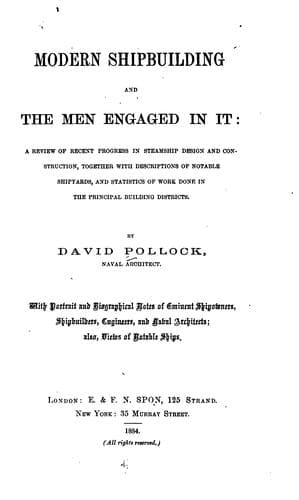
Modern shipbuilding and the men engaged in itPollock, David
History
Modern shipbuilding and the men engaged in it
Pollock, David
Shipbuilding -- Great Britain
The oldest method of approximating to the horse-power required
to propel a proposed vessel at a given speed is to compare the
new ship with ships already built by the use of formulæ known
as “co-efficients of performance” deduced from the results of
their speed trials. Two such co-efficients have been deduced from
Admiralty practice, the one involving displacement, the other area of
mid-section, with speed as the variable in both cases. Another method
which has been largely used, consists in first determining the ratio
of the indicated horse-power to the amount of “wetted surface,” or
immersed portion of the vessel’s skin, in the exemplar ship, and then
estimating from this ratio the probable value of the corresponding
ratio for the proposed ship at her assigned speed. Inasmuch as these
methods of procedure do not take account of the _forms_ of the hulls,
and consequently of that factor in the total resistance due to
_wave-making_, they cannot be used with any degree of confidence, or
without large corrections, except in connection with vessels whose
speeds are moderate in proportion to their dimensions: those in fact
in which the resistance varies nearly as the square of the speed. A
further method, somewhat resembling the one based upon the relation
between indicated horse-power and the “wetted surface,” was proposed
by the late Prof. Rankine, but has never been extensively employed.
Apart from the unreliable nature of the results which an application
of it gives—except for certain speeds—it is open to several serious
objections in practice.
A method of analysis and prediction, meeting with considerable
acceptance from shipbuilders on the Clyde and elsewhere, has been
introduced within recent years by Mr A. C. Kirk, of Messrs R. Napier
& Sons.[20] The method consists in reducing all vessels to a definite
and simple form, such as readily admits of comparison being made
between their immersed surface, length of entrance and angle of
entrance and their indicated horse-power, and from this judging of
the form and proportions best suited to a given speed or power in
proposed vessels. The form in question consists of a block model,
having a rectangular midship section, parallel middle body, and
wedge-shaped ends; its length being proportioned to that of the ship,
its depth to the mean draught of water, its girth of mid-section
to the girth of immersed mid-section of the ship, and the surface
of its sides, bottom and ends, to the immersed surface of the ship.
By finding from one or more exemplar ships—the selection of which
is obviously governed by the conditions of analysis—the rate of
indicated horse-power required per unit of wetted surface at the
speed assigned for the proposed vessel, the appropriate rate for the
latter may easily be determined.
Public-domain text, read in full here on John Shaqi.
Reviews
Reviews
No reviews yet
Be the first to share your thoughts on this work.
Elsewhere in the archive
Join the Discussion
Join the discussion
Sign in to leave a comment or review.
Sign InorCreate an account