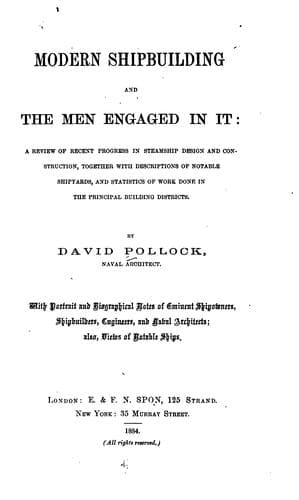
Modern shipbuilding and the men engaged in itPollock, David
History
Modern shipbuilding and the men engaged in it
Pollock, David
Shipbuilding -- Great Britain
Although the results obtained by an application of Mr Froude’s
analysis to the trials of a large number of merchant vessels have
undoubtedly thrown considerable light on the relative efficiency of
hull and engines, and of various types of engines, still, for several
reasons adduced by extended experience—most of which, indeed, were
foreseen and perfectly appreciated by Mr Froude himself—the need has
been felt for some means of directly measuring the power actually
delivered to the propellers by the engines when working at different
speeds. One of Mr Froude’s latest inventions, the perfecting of
which was not accomplished until after his death, consisted of a
dynamometric apparatus designed to accomplish this important end.[25]
The construction of the instrument was undertaken for the Admiralty,
and trials were made with it on H.M.S. _Conquest_ in the early part
of 1880. The results of these experiments have not yet in any form
been recorded, but there can be no question as to the benefit that
would accrue to the profession if the Admiralty could be induced to
publish these, as well as the results of other experiments with this
instrument.
Experiments with actual vessels to determine directly the relative
efficiency of hull, engines, and propellers have on several occasions
been undertaken. A series of trials of this nature were made in 1874
by Chief-Engineer Isherwood, U.S. Navy on a steam launch, the results
of which may be found detailed in the Report of the Secretary of U.S.
Navy for 1875. Similar trials have been made recently on the United
States steamer _Albatros_, an interesting account of which appeared
in _Engineering_ of October 17 of the present year. These experiments
are referred to as notable examples of what might be carried out
with great advantage on other and larger vessels, although they are
such, perhaps, as few single firms can well be expected to follow
extensively.
The economies which may be obtained by changes in the propellers
fitted to ships, and the great value of progressive speed trials
as a means of measuring the effects of such changes, received most
remarkable illustration in the results of the trials of H.M.S.
_Iris_, carried out for the Admiralty in 1880. These showed that
by simply varying the propellers—all other conditions remaining
practically unchanged—the speed of the ship was increased from 16½
to 18½ knots per hour. Scarcely less striking improvements in the
performances of vessels due to changed propellers might be found from
the records of trials made with merchant vessels within recent years.
Public-domain text, read in full here on John Shaqi.
Reviews
Reviews
No reviews yet
Be the first to share your thoughts on this work.
Elsewhere in the archive
Join the Discussion
Join the discussion
Sign in to leave a comment or review.
Sign InorCreate an account