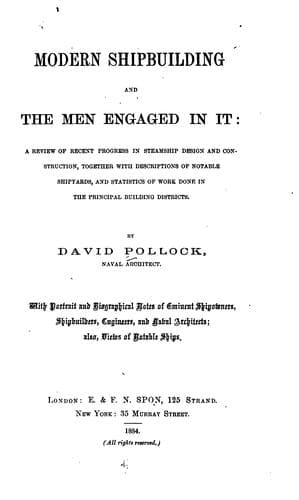
Modern shipbuilding and the men engaged in itPollock, David
History
Modern shipbuilding and the men engaged in it
Pollock, David
Shipbuilding -- Great Britain
“May I urge upon shipbuilders the importance of endeavouring to
extend the application of power riveting to the shell plating of
iron vessels. By this means we shall both increase the frictional
resistance, and also, by more completely filling the rivet
holes, vastly improve the rigidity of the riveted joints. The
difficulty of completely and exactly filling the counter-sink of
a counter-sunk hole with a machine-closed rivet suggested to my
friend Mr Kirk the idea of entering the rivet from the outside,
both the rivet and the counter-sink being made to gauge, and then
closing up with a machine snap-point on the inside of the ship.
What progress he has made in this direction I do not know, but the
difficulty does not appear to be an insuperable one. If however,
we are prepared to sacrifice a fair appearance to utilitarian
simplicity, there seems no sufficient reason why, above water, all
the rivets should not be closed up with snap heads and points,
both inside and outside. In whatever way it is accomplished, I
look to the use of machine riveting as one very great step in
advance in the future improvement of the riveted joints of iron
ships; and if the weight of iron vessels is to be reduced in any
important degree, or if the dimensions and proportions of large
merchant steamers are to increase in the future as they have done
in the past, I feel sure that one of the first steps must be the
reconsideration of our butt fastenings.”
The increased engine power now demanded in steamships undoubtedly
points to the further adoption of mechanical riveting—if vessels
are to successfully withstand the enormous strain and vibrations to
which they are thereby subject. While several have already shown
drawings of the shell difficulty having been met, Mr Tweddell, whose
experience in common with that of his manufacturers and co-patentees,
Messrs Fielding & Platt, of Gloucester, may justly be considered
greatest in this branch of engineering, has never illustrated this.
It may be mentioned, however, that excellent flush riveting is
constantly done by the Tweddell hydraulic riveters, and that the
same plan suggested by Mr Kirk of entering rivets with prepared
counter-sunk heads from one side, and snap pointing them by machine
on the other has been long in use by Messrs Fielding & Platt. In
conjunction with Mr Tweddell, this firm have also designed several
efficient arrangements to ensure the machine being kept in position
until the unfinished head of the rivet is formed. Judging from
these facts, there seems good reason to hope that the production of
riveting machines required to overtake the remaining features will
not be very long delayed.
Public-domain text, read in full here on John Shaqi.
Reviews
Reviews
No reviews yet
Be the first to share your thoughts on this work.
Elsewhere in the archive
Join the Discussion
Join the discussion
Sign in to leave a comment or review.
Sign InorCreate an account