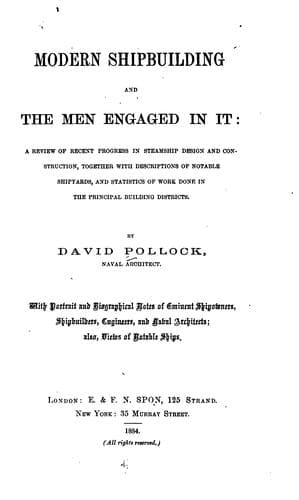
Modern shipbuilding and the men engaged in itPollock, David
History
Modern shipbuilding and the men engaged in it
Pollock, David
Shipbuilding -- Great Britain
The means of transporting material in shipyards by systems of
railways laid alongside the principal workshops, and traversing the
yard in all directions, have been amplified and improved in many
yards within recent times. Connection is made in most instances with
sidings from main lines of railway, whereby materials and goods can
be at once brought into the yards from whatever part of the kingdom;
and in the largest yards special locomotives are constantly employed
doing this work. In well arranged establishments the railway first
enters a store-yard, and the material is lifted from the trucks by
travelling-crane or other means, and deposited on either side of the
railway, plates being set on edge in special racks, from which they
can be easily removed by the workmen. Leaving this, the lines of
railway traverse the building yard throughout, and are designed to
permit of the material being conveyed without retrocession, but with
the necessary stoppages for its being put through the various courses
of manipulation, to the vessel in which it is to be used. A recent
and very serviceable amplification of the system of railway transport
has been fitted in one of the largest Clyde yards which enables
material to be conveyed with greatly increased ease and despatch in
directions and to situations wholly inaccessible to the main lines
of rails. This is the narrow gauge portable system, patented by M.
Decauville, of Petit-Bourg, Paris, which consists of short lengths of
very light steel rails, permanently riveted to cross sleepers, and
with end connections so formed as to make joint while being pressed
into contact. Each section, of 4, 6, 8, 12, or 16 feet long, being
complete in itself, the tramway can be laid down in any new situation
very rapidly. Where divergences of route take place, curves,
crossings, and light turntables are supplied, sufficiently strong
to carry working loads, and at the same time light enough to be
easily handled. Special waggons and trollies are also supplied by the
makers, which, combined with the system of portable rails described,
not only worthily take the place of, but far excel in handiness and
efficiency, the ordinary wheel-barrows of the shipyard.
List of Papers, &c., bearing on modern shipyard machine-tools,
appliances, and methods of work, to which readers desiring fuller
acquaintance with the _technique_ and details of the subject are
referred:—
ON THE HYDRAULIC DEPARTMENT IN THE IRON SHIPBUILDING DEPARTMENT
OF THE NAVAL DOCKYARD AT TOULON, by M. Marc Berrier-Fontaine:
Proceedings Inst. Mech. Engineers, 1878.
ON THE APPLICATION OF HYDRAULIC PRESSURE TO MACHINE TOOLS, by Mr
Ralph Hart Tweddell: Trans. Inst. Engineers and Shipbuilders, vol.
xxiv., 1880-81.
ON MACHINE-TOOLS AND OTHER LABOUR-SAVING APPLIANCES WORKED BY
HYDRAULIC PRESSURE, by R. H. Tweddell: Proceedings Inst. Civil
Engineers, vol. lxxiii., 1882-83.
Public-domain text, read in full here on John Shaqi.
Reviews
Reviews
No reviews yet
Be the first to share your thoughts on this work.
Elsewhere in the archive
Join the Discussion
Join the discussion
Sign in to leave a comment or review.
Sign InorCreate an account