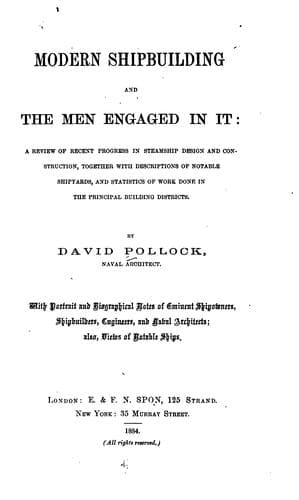
Modern shipbuilding and the men engaged in itPollock, David
History
Modern shipbuilding and the men engaged in it
Pollock, David
Shipbuilding -- Great Britain
The works, which are situated on the south bank of the Clyde at
Fairfield, near Govan, occupy an area of about 70 acres, and
comprise shipyard, boiler shop, engine works, and tidal basin.
The disposition of the various workshops is admirable, and as
these are connected with each other by a broad gauge line of
rails communicating with all parts of the yard and the terminus
of the Govan railway, the conveyance of raw material in the first
instance, its location in whatever section of the works it may
be specially designed for, and its transmission in the form of
finished items of structure or outfit to the vessels of which it is
to form part, are all accomplished with ease.
Entering by the south-east gate, the visitor proceeds in the
direction of the business offices, his first impression probably
being one of wonder at the immense quantities of iron and steel in
plates and bars covering every available piece of ground, as well
as the great quantity of timber of all dimensions stacked and in
racks, maturing for after use. Arriving at the offices of the firm,
the visitor is probably first ushered into the draughtsmen’s rooms,
which, as well as a large reception-room, contain an extensive
collection of models of the vessels that have been constructed by
the firm. In these apartments a large staff of draughtsmen are
employed in the work of designing new vessels, and making working
drawings of ships already contracted for.
Following the routine of practical operations the visitor is
conducted to the moulding loft, which is 320 feet long by 50 feet
wide. Here the drawings of the vessels are put down full size.
The term “laying off” is applied to the operation of transferring
to the mould loft-floor those designs and general proportions of
a ship which have been drawn on paper, and from which all the
preliminary calculations have been made and the form decided. The
lines of the ship and exact representations of many of the parts
of which it is composed are delineated here to their actual or
real dimensions, in order that moulds or skeleton outlines may be
made from them for the guidance of the workmen. These lines, when
completed and carefully verified, are afterwards transferred to
scrieve boards, from which the frames, floors, &c., are bent. In
connection with the moulding loft is a pattern shop, in which the
various moulds required in “laying off” are made.
Public-domain text, read in full here on John Shaqi.
Reviews
Reviews
No reviews yet
Be the first to share your thoughts on this work.
Elsewhere in the archive
Join the Discussion
Join the discussion
Sign in to leave a comment or review.
Sign InorCreate an account