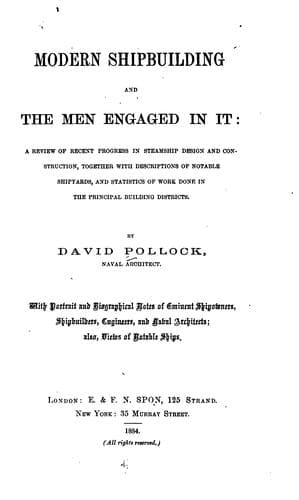
Modern shipbuilding and the men engaged in itPollock, David
History
Modern shipbuilding and the men engaged in it
Pollock, David
Shipbuilding -- Great Britain
It is almost unnecessary further to give the particulars of
this establishment, suffice it to say that it is being laid out
on the experience gained up to date in existing shipyards, and
will therefore embrace the newest and most important tools in
all branches of work. The intention is that it shall be capable
of turning out every description of vessel up to the largest
iron-clad, and the construction of war vessels of all kinds will
be made a speciality, seeing that the Company can send them to sea
completely armed and equipped ready for service. Looking to the
magnitude of the establishment, it can be regarded as nothing less
than an arsenal, which in time of war would be invaluable to the
country. The present and prospective importance of this development
of the combined firms’ business may be inferred simply from the
fact of the services of so high an authority as Mr W. H. White,
late Chief Constructor of the Navy, having been secured as naval
adviser and manager.
DEPTFORD SHIPBUILDING YARD AND REPAIRING DOCKS, SUNDERLAND.
These works, established so far back as 1793, but greatly
transformed and extended to suit modern requirements, are owned
and presided over by Mr James Laing, son of Mr Philip Laing, their
founder. The yard consists of two general sections, situated one
on each side of the main road leading to the river Wear. One of
these, commonly termed the “Woodyard,” is where wood shipbuilding
was conducted in the early days, but which now of course, in common
with the other section, is used exclusively for iron shipbuilding.
The entire works, including offices, docks, brass foundry, and
other premises, cover an area of about thirty acres.
The yard embraces the various shops and sheds usually pertaining to
building operations in iron, such as iron-working sheds, smiths’
shop, joiners’ shop, upholsterers’ shop, bookmakers’ shop, &c.,
all well equipped with machine-tools and appliances, needful in
producing vessels for the most important shipping companies. The
two general sections of the yard are each worked by one compound
surface condensing engine, all machines being driven by belting
from main lines of shafting, no independent engines being fitted.
Scrive-boards, frame furnace, bending blocks, garboard bender,
and other machinery are fitted in each section. Gorman’s gas
furnaces are used for heating the material, and these, though
rather troublesome when first fitted, about twelve years ago, after
some alterations in the details, now give complete satisfaction,
and surpass in efficiency ordinary coal furnaces. The joiners’
shop is situated in the wood-yard, and the smith’s shop in the
other section. In the smith’s shop a separate engine is provided
to drive the blast, so that if it is desired the wood-yard can be
kept completely going without having the main engine in the other
section at work.
Public-domain text, read in full here on John Shaqi.
Reviews
Reviews
No reviews yet
Be the first to share your thoughts on this work.
Elsewhere in the archive
Join the Discussion
Join the discussion
Sign in to leave a comment or review.
Sign InorCreate an account