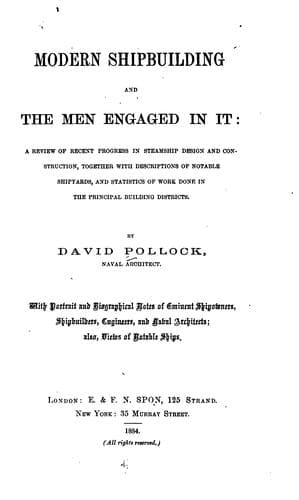
Modern shipbuilding and the men engaged in itPollock, David
History
Modern shipbuilding and the men engaged in it
Pollock, David
Shipbuilding -- Great Britain
CHAPTER VII.
OUTPUT OF TONNAGE IN THE PRINCIPAL DISTRICTS.
With the change from wood to iron shipbuilding, and with the
development of propulsion by steam instead of sails, the shipbuilding
industry has become localised and concentrated in those districts
which, besides possessing the _sine qua non_ of ready outlet to
the vast ocean, are specially favoured in being the repositories
of immense natural wealth in the form of coal and ores. What may
now fairly be considered the great centres of shipbuilding are the
valleys of the Clyde, Tyne, Wear, and Tees, and also the Thames and
Mersey, although these latter rivers have for a considerable number
of years been overshadowed as building centres by the immensity of
their shipping. In several other districts, of course, shipbuilding
is carried on to a considerable extent, and some of these may
yet attain much greater importance than they at present possess.
Barrow-in-Furness, notwithstanding the remarkable progress of recent
years, is still advancing. Belfast occupies a prominent position, not
alone because of the large annual output of tonnage, but by reason
of the number of high-class ocean steamships which have been, and
continue to be, built there. Dundee, Leith, Hull, Southampton, and
other places throughout the United Kingdom, are not without claims to
recognition on account of the shipbuilding carried on.
The supremacy of one shipbuilding centre over another in the matter
of work accomplished, both with regard to its character and its
quantity, not infrequently forms the subject of comment in the
columns of journals circulating in the districts concerned. The
publication, by these journals, at the close of each year, of the
returns of new tonnage produced by the various firms, affords an
opportunity for vaunting on such matters, and it is, as a rule, taken
advantage of by the compilers of the statements, who are usually
members of the staff on the journals in question. These statements,
through the interesting nature of the statistics they contain, are
widely read, and the labour attaching to their preparation must
indeed be considerable. The figures are, as a rule, supplied by
the shipbuilders themselves, and from a summation of these the
compiler draws his conclusions. The accuracy of the returns and the
fairness of the comments based upon them, if not always completely
satisfactory, are thus seen to be matters for which the compiler is
not wholly responsible.
Public-domain text, read in full here on John Shaqi.
Reviews
Reviews
No reviews yet
Be the first to share your thoughts on this work.
Elsewhere in the archive
Join the Discussion
Join the discussion
Sign in to leave a comment or review.
Sign InorCreate an account