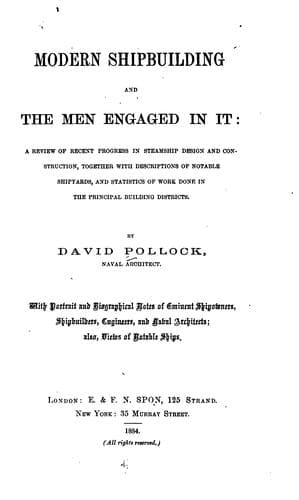
Modern shipbuilding and the men engaged in itPollock, David
History
Modern shipbuilding and the men engaged in it
Pollock, David
Shipbuilding -- Great Britain
During the years 1871, 1872, and 1873 the output from the Clyde yards
averaged 50 per cent. of the total shipping produced throughout the
United Kingdom. That high proportion fell for the years 1874, 1875,
and 1876 to as low as 37½ per cent. In 1882 the Clyde’s contribution
to the grand total did not exceed 32½ per cent., so that in one
decade the premier shipbuilding centre has fallen from the proud
position of producing half the total shipping built within the United
Kingdom to that of turning out less than one-third. Mr William
Denny, dealing with this subject in a paper on the “Industries of
Scotland,” read before the Philosophical Society of Dumbarton, in
December, 1878, attributed the then condition of affairs with regard
to the tonnage output of the Clyde to the keen competition of the
builders on the North-East Coast of England, who managed to produce
their favourite type of heavy-carrying, slow-speed steamers at very
much less cost than could be done on the Clyde. Their success in this
he attributed to four causes—1st, to the enterprise of the small
shipowners and the general public on the North-East Coast of England
in supplying capital for steamers of this kind; 2nd, to the great
cheapness of iron in that district; 3rd, to the long hours worked,
enabling the shipbuilding plant to be more profitably employed, and
to the great development of piece-work; 4th, to the fact that all
the builders being engaged upon work of the same class, the price of
which could be measured per ton of dead-weight carried, or per ton
gross, and per nominal horse-power, they were able easily to compare
the efficiency of each other’s yard in point of production, and by
that means a keen competition was produced amongst each other. On the
Clyde the great variety and frequent speciality of the work prevented
any such common measure of prices existing. This way of accounting
for the altered relative positions of the chief shipbuilding centres
was doubtless at that time the correct one, and to a large extent it
still holds true. The productiveness of the North-East Coast ports
has in no way declined since, notwithstanding that a larger number
of the higher class passenger ships which have long been so much a
Clyde speciality are now being constructed there. But the number of
yards everywhere have increased in a higher ratio than on the Clyde,
and consequently the aggregate of new shipping produced annually
in the United Kingdom is made up of a greater number of separate
contributions. That this is mainly the reason of the present position
of the Clyde relatively to the whole United Kingdom is proved by the
figures contained in the accompanying table, which show, amongst
other things, that the ratio of tonnage produced by each of the
principal districts to the total produced by the whole of them, has
not very much altered during the past six years, or since Mr Denny
spoke on the subject. If anything, indeed, the Clyde shows in this
Public-domain text, read in full here on John Shaqi.
Reviews
Reviews
No reviews yet
Be the first to share your thoughts on this work.
Elsewhere in the archive
Join the Discussion
Join the discussion
Sign in to leave a comment or review.
Sign InorCreate an account