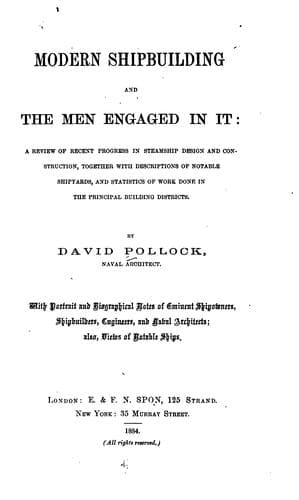
Modern shipbuilding and the men engaged in itPollock, David
History
Modern shipbuilding and the men engaged in it
Pollock, David
Shipbuilding -- Great Britain
With respect to the progress of shipbuilding in steel, little
requires to be added to the general account given in Chapter I.
The tonnage annually produced in steel is a constantly-increasing
quantity. Hitherto the Clyde has contributed quite three-fourths of
the tonnage of steel vessels, owing chiefly to the vigorous way in
which certain of the shipbuilders there have adopted the practice,
and also to the openness of the local field for the extensive
manufacture of the new material. The North-East Coast, however, bids
fair, in the immediate future, to become as productive in steel
tonnage as the Clyde district. Recently-discovered processes by
which the vast stores of Cleveland ironstone may be made profitably
available in steel manufacture are working great changes in the way
of modifying old and causing the erection of new works.
The extraordinary growth of steel shipbuilding since its commencement
in 1878 is well illustrated by the accompanying tables, which are
taken from a paper by Mr W. John, on “Recent Improvements in Iron
and Steel Shipbuilding,” read at the meetings of the Iron and Steel
Institute in May of the present year. The figures relating to steel
may be taken, where any divergence occurs, as more authoritative
than those occurring in the general account of work in steel in
Chapter I. The tables, however, partake of the imperfections already
fully alluded to in the present chapter. With regard to them, Mr
John says:—“Unfortunately, neither of these tables show the actual
amount of shipping, either steel or iron, built in this country,
because there would have to be a small percentage, perhaps between
ten and twenty, to be added to those classed at Lloyds on Table I.
for unclassed ships, and there would be a certain proportion, which
I am unable to ascertain, to be added to the figures on Table II.
for ships built for foreign owners in this country, and not entered
upon the British register. However, the figures in themselves are
sufficiently significant of the enormous growth of steel shipbuilding
within the last six years, and it will be seen at once, as I
have said before, that steel as a material for shipbuilding has
passed entirely out of the experimental stage, and must be judged
henceforth by the results of its working in the shipyards, and by
the results of the performances of the ships already afloat, both
as profit-earning machines for their owners, by their general wear
and tear, for their safety against strains at sea, and in cases of
collision and stranding.”
_Table I.—Statement showing the Number and Tonnage of Steel and Iron
Vessels Classed by Lloyd’s Register of British and Foreign Shipping
during the Years 1878 to 1883, both inclusive._
Public-domain text, read in full here on John Shaqi.
Reviews
Reviews
No reviews yet
Be the first to share your thoughts on this work.
Elsewhere in the archive
Join the Discussion
Join the discussion
Sign in to leave a comment or review.
Sign InorCreate an account