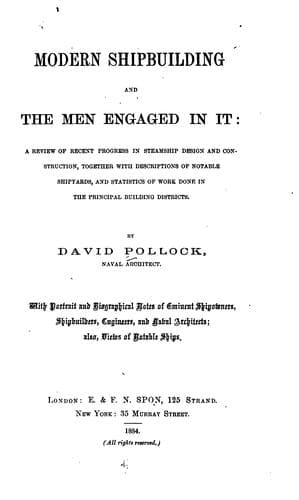
Modern shipbuilding and the men engaged in itPollock, David
History
Modern shipbuilding and the men engaged in it
Pollock, David
Shipbuilding -- Great Britain
Born in Glasgow in 1842, where his father, Mr Anthony Inglis, and
Mr John Inglis, his uncle, were marine engineers, subsequently also
becoming iron shipbuilders. Under the designation of A. & J. Inglis
the combined businesses—the engineering works at Warroch Street, and
the shipyard at Pointhouse—have been conducted with marked success.
Having for some years attended the Glasgow Academy, Mr INGLIS,
at the age of fifteen, entered the University, where for several
sessions he studied under such teachers as the late Professors
Ramsay, Blackburn, and Rankine, and also under Sir William Thomson.
Of Professor Blackburn’s mathematical and Professor Rankine’s
engineering classes Mr INGLIS was a distinguished student; in the
former—although the youngest on the roll—carrying off several prizes,
and in the latter acquiring a sound knowledge of applied mathematics
as concerned with engineering and naval architecture. This experience
was afterwards supplemented by a term’s apprenticeship in the
practical work of the engine shop. The art of naval construction,
however, had always irresistible attraction for Mr INGLIS, and in
1867 he seriously applied himself to the concerns of the shipyard,
taking an active share in its management ever since. Mr INGLIS’
career, though uneventful, has been one of assiduous devotion to
the profession of Naval Architecture, especially as directed to
scientific investigation and analysis. The fruits of this are
reflected in many noteworthy and specialized steam vessels produced
by his firm. Was the first shipbuilder on the Clyde to follow the
practice of inclining vessels to ascertain their stability, and was
one of the earliest on the Clyde to apply the correct method of
estimating longitudinal strains to the hulls of steamers. His firm
have been noted for the careful and elaborate trials of steamers on
the measured mile, and the digesting of such data. Is the author of
several papers read before the societies with which he is connected,
one of which fully described the system of speed trial and analysis
above referred to. The designing and sailing of yachts are favourite
pursuits of Mr INGLIS; and the system of yacht ballasting by means
of a lead keel forming portion of the hull structure was first
instituted by him in one of the many yachts built for his own use.
Under the title of “A Yachtsman’s Holidays,” he published, some years
ago, a volume giving a racy account of yachting experiences in the
West Hebrides. He wields a forcible pen, and it is not unfrequently
employed anonymously in the interests of shipbuilding and naval
science.
[Illustration: Yours faithfully John Inglis Junr (signature)
INK-PHOTO, SPRAGUE & C^o. LONDON.]
PORTRAIT
AND
BIOGRAPHICAL NOTE.
SIR EDWARD J. REED.
SIR EDWARD J. REED, K.C.B., F.R.S., M.P.
VICE-PRESIDENT OF THE INSTITUTION OF NAVAL ARCHITECTS; MEMBER OF
COUNCIL OF THE INSTITUTION OF CIVIL ENGINEERS, AND MEMBER OF THE
INSTITUTION OF MECHANICAL ENGINEERS.
Public-domain text, read in full here on John Shaqi.
Reviews
Reviews
No reviews yet
Be the first to share your thoughts on this work.
Elsewhere in the archive
Join the Discussion
Join the discussion
Sign in to leave a comment or review.
Sign InorCreate an account