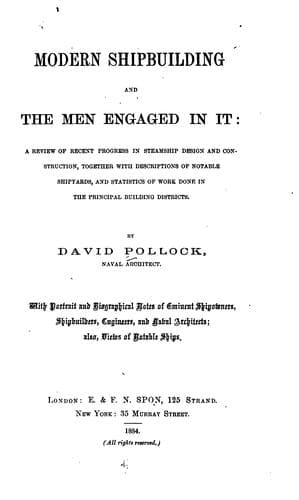
Modern shipbuilding and the men engaged in itPollock, David
History
Modern shipbuilding and the men engaged in it
Pollock, David
Shipbuilding -- Great Britain
[1] Since the above was written, the _Aurania_ and the _Oregon_ have
resumed their services on the Atlantic, the results in the case of
the latter vessel being extraordinarily successful. On Saturday,
the 5th April, she arrived at Queenstown, having left New York on
Saturday, the 29th March, making the trip in 7 days, 2 hours, 18
minutes, her daily runs being:—45, 407, 396, 400, 302, 410, 384, 412,
and 60; total, 2816 knots. Leaving Queenstown on Sunday, the 13th
April, she arrived at New York on Saturday, the 19th April, in the
unprecedentedly short period of 6 days, 9 hours, 22 minutes.
[2] While these sheets were passing through the press, the _America_
was tried unofficially on the Clyde, and attained a speed of 17
knots, with about 6,500 indicated horse-power. On her passage from
the Clyde to the Mersey she maintained, it is stated, 18¼ knots over
the whole distance.
[3] This list with those which follow other chapters, have been
compiled at considerable trouble in the hope that they may be of
use to technical readers in directing them at once to accurate and
detailed information. In this connection also, the excellent work by
Mr A. S. Seaton, “Manual of Marine Engineering,” and that by Mr W. H.
White, “Manual of Naval Architecture,” may be referred to with every
satisfaction.
[4] For full and excellent treatment of this subject, see the paper
on “Causes of Unseaworthiness in Merchant Steamers,” by Mr Benjamin
Martell, Chief Surveyor to Lloyd’s Register, with the ensuing
discussion: Trans. Inst., N.A., vol. xxi., 1880.
Several of the causes above named it is doubtless the province of the
scientific shipbuilder, and the duty of the shipowner, to obviate
by furnishing the captain and officers—especially in the case of
entirely new vessels—with particulars and data of the vessel’s
technical character, such as are now left to be found out by slow
and sometimes bitter experience. Of these it may be sufficient
to instance:—Stability, steadiness, trim, carrying capability,
and steaming powers. Mr William Denny, of Dumbarton, has recently
publicly declared his firm’s intention of supplying such particulars
to the vessels built by them. It is to be hoped this worthy example
may be extensively followed.
[5] In this, as in other matters dealt with, the full appreciation of
which involves careful technical study, readers are referred to the
papers enumerated at the end of chapter, as well as to the “Manuals”
already referred to in this work.
Public-domain text, read in full here on John Shaqi.
Reviews
Reviews
No reviews yet
Be the first to share your thoughts on this work.
Elsewhere in the archive
Join the Discussion
Join the discussion
Sign in to leave a comment or review.
Sign InorCreate an account