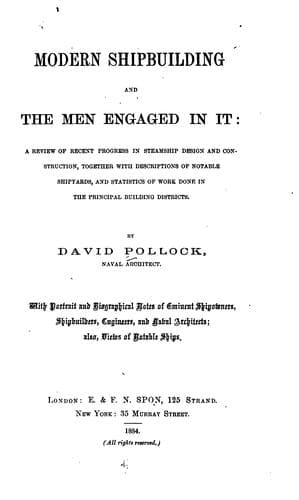
Modern shipbuilding and the men engaged in itPollock, David
History
Modern shipbuilding and the men engaged in it
Pollock, David
Shipbuilding -- Great Britain
[9] Suppose the dimensions of a proposed vessel to be 320 × 36 × 26½
feet, then, according to a method of approximation largely in use,
the sum of these dimensions divided by 100 gives what is known as the
“cubic number”—(320 × 36 × 26½ ÷ 100) = 3052 cubic number. Suppose
that for a vessel already built, similar in type and dimensions,
or of similar proportions, to the one proposed, the cubic number,
when divided into the ship’s actual weight (_i.e._, the displacement
_minus_ the weight of machinery and the dead-weight carried),
gives say ·53, then this figure represents the “co-efficient” of
ship’s weight, and applying it in the case supposed gives:—3052 ×
·53 = 1620, the weight of hull for proposed vessel. This example
illustrates the manner in which the weight of machinery is estimated,
and indicates the nature and use of the general term “co-efficient:”
frequently employed in this chapter.
[10] One such method, devised and followed by Mr C. Zimmermann in
his daily practice as chief draughtsman to the Barrow Shipbuilding
Company, and described by him before the Institution of Naval
Architects in 1883, gives with very little preliminary calculation,
and at once, a close approximation to the correct displacement.
Another system, originated and used in practice by Mr Chas. H.
Johnson, chief designer to Messrs Wm. Denny & Brothers, consists of
an analysis of the lines of vessels of various degrees of fineness
and fulness previously built, formulated for daily use in a series of
curves of areas, giving, for sections at certain fixed distances from
midships—in terms of percentage to the midship area—the particular
area specially suited to afford the required displacement; and at
the same time to maintain the general form of hull which in actual
practice has proved satisfactory with respect to speed. In his later
practice, Mr Johnson has found it preferable to use the block form of
analysis of Mr A. C. Kirk (considered further on in matters relating
to speed), using the three sides of that form as a basis upon which
to group the water-lines.
[11] For illustrated descriptions of this and other improved
calculating instruments referred to in this chapter, see Appendix.
Public-domain text, read in full here on John Shaqi.
Reviews
Reviews
No reviews yet
Be the first to share your thoughts on this work.
Elsewhere in the archive
Join the Discussion
Join the discussion
Sign in to leave a comment or review.
Sign InorCreate an account