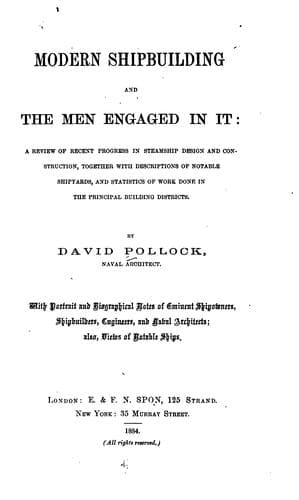
Modern shipbuilding and the men engaged in itPollock, David
History
Modern shipbuilding and the men engaged in it
Pollock, David
Shipbuilding -- Great Britain
themselves have too often insisted on exercising functions and
dictating in matters which only may be determined with propriety and
safety by builders or by competent naval architects.
The amount of thorough supervision to which a vessel is subjected
while under construction, renders the fear of unseaworthiness, from
either defective construction or equipment, the least reasonable
of all the fears with which ocean navigation is regarded. It is in
later circumstances, and concerning matters of a more extraneous
character, that the most justifiable fears may be entertained
regarding a vessel’s safety. Overloading, improper stowage, bad
management, under-manning, insufficient repair, besides the numerous
inevitable and unforeseen circumstances incidental to sea-voyaging,
may be instanced as the causes to which the greatest losses are
attributable.[4] Few instances of loss from structural defects are
adduceable, and even in these, causes of a more or less extraneous
character are associated with the loss. On the other hand, instances
could be multiplied where vessels sustaining the casualties which
rough weather or rank carelessness make always imminent have come
out of the ordeal with credit to the constructors. One notable case
may be instanced. The _Arizona_, of the Guion Line, some time after
being put on the Atlantic service, while steaming at a speed of 14
knots, and almost in mid-Atlantic, ran into an iceberg of gigantic
dimensions, and notwithstanding that the force of the concussion
smashed her bows for a length of 20 feet into an unrecognisable mass,
she kept afloat, and reached a port of safety.
Where, as has already been indicated, there is such close oversight
and thorough supervision—where, indeed, the real interests of every
party honestly concerned lie so clearly in the high qualities of
construction—nothing short of such results as the foregoing should be
expected. The insurance companies, on whom the burden (monetary at
least) of loss at sea ultimately falls, see it their interest to know
that those registration societies, on whom they rely for guarantee
as to a vessel’s structural and general efficiency, are themselves
efficient and trustworthy authorities. These societies, known as
Lloyd’s, Liverpool Underwriters, and Bureau Veritas, Registries, in
spite of the dread as to business rivalry affecting injuriously their
standards of classification, have still a high criterion, and enjoy
the confidence of insurance societies and shipowners alike.
Public-domain text, read in full here on John Shaqi.
Reviews
Reviews
No reviews yet
Be the first to share your thoughts on this work.
Join the Discussion
Join the discussion
Sign in to leave a comment or review.
Sign InorCreate an account