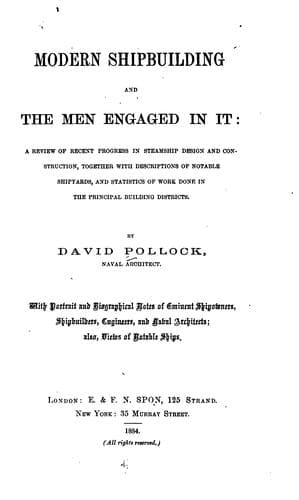
Modern shipbuilding and the men engaged in itPollock, David
History
Modern shipbuilding and the men engaged in it
Pollock, David
Shipbuilding -- Great Britain
The development in the size of steamships not only affects the
quality of safety, but also in various ways the element of comfort at
sea. The greater length, for instance, is calculated to neutralise
the longitudinal oscillation, the effects of which are so often fatal
to the comfort of passengers. Again, the great length affords an
advantage in the way of allowing better state-room accommodation; all
the rooms, or a larger proportion of them, being next the vessel’s
side, and consequently more airy and better lighted. It is not,
however, in the increased length so much as in the development of all
three dimensions, and especially in the increased ratio of breadth
to length, that modern types of steamships are enhanced in the
qualities of safety and comfort. Mistaken or imperfect notions as to
the ratio most desirable for speed, have kept in perpetuity types of
steamers which the fuller light of modern scientific investigation
has shown to be undesirable. Great beam is now believed to be not
incompatible with great speed, and even apart from questions of speed
the advantages accruing from breadth are better appreciated.
As an illustration of this movement, one of the more recent of
the many transatlantic mail steamships may be instanced. In the
_Aurania_, of the Cunard Company, the proportions—although perhaps
only in the line along which modern professional ideas tend—are
certainly in advance of the general practice with regard to vessels
of her great size. The dimensions of the _Servia_, the _Alaska_,
and the _City of Rome_—three vessels comparable with the _Aurania_
as constituting the largest merchant vessels afloat—all give a
proportion of 10 beams to the length. The _Aurania’s_ dimensions—470
feet by 57 feet by 39 feet—show her to have only about 8¼ beams to
length. The success of the older type of vessel having proportions
somewhat similar to this “modern instance” has in no material
sense been eclipsed by the narrow types which subsequently for
so long prevailed. Availing themselves of that freedom which
independence of the registration societies yield—their vessels not
being “classed”—the Cunard Coy determined to adopt the old-time
proportions. The step has been justified, in so far as affected by
the matter of speed, the powerful vessel, at her trials on the Clyde,
having attained a mean speed of 17¾ knots, or 20½ statute miles, per
hour. The stable qualities due to the great breadth of the _Aurania_
has in actual service further confirmed the wisdom of the change. The
magnificent vessels presently building on the Clyde for the Cunard
Coy., though between 20 and 30 feet longer, are the same breadth as
the _Aurania_, _i.e._, 57 feet. This is accounted for by the fact
that the breadth of beam fixed for the _Aurania_ was the largest
amount permissible, having regard to the breadth of entrance of the
largest dock in New York. This _en passant_ is worthy of notice as
giving colourable justification to the complaints sometimes made that
Public-domain text, read in full here on John Shaqi.
Reviews
Reviews
No reviews yet
Be the first to share your thoughts on this work.
Elsewhere in the archive
Join the Discussion
Join the discussion
Sign in to leave a comment or review.
Sign InorCreate an account