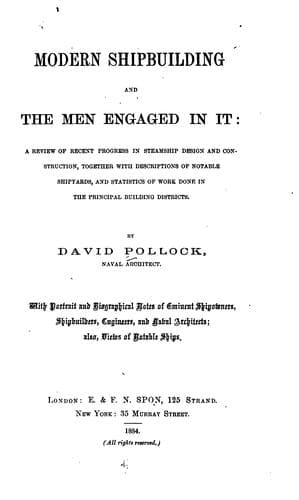
Modern shipbuilding and the men engaged in itPollock, David
History
Modern shipbuilding and the men engaged in it
Pollock, David
Shipbuilding -- Great Britain
The work in electric lighting on board ship for the year 1883 shows
how firmly the electric system has become established as the only
system for first-class passenger vessels. The report of the Edison
& Swan United Companies embraces the work on thirty-one vessels,
including three Indian troopships (and four more on order), four
vessels for the Clan Line, one for the Peninsular and Oriental
Company, one for the Union Steamship Company, three for the Cunard
Company, three for the British India Steam Navigation Company, three
for the New Zealand Shipping Company, and so on. The list of Messrs
Siemens Brothers amounts to twenty high-class vessels, including the
_Arizona_, the _Servia_, the _Aurania_, the _City of Rome_, the _City
of Chicago_, the _Austral_, the _Germanic_, and the _Massilia_. These
two firms thus give fifty-one vessels, and adding those entrusted to
outsiders—four in all—affords a total of fifty-five, representing an
aggregate of not less than 11,000 incandescent lamps.
[Illustration: FIG. 11.
EDISON LAMP.]
The application of the electric light on board ship to the purposes
of signalling, as a substitute for the ordinary system of oil
lanterns, has been fully shown in theory and already partially
effected in practice, but its development in this direction is
necessarily retarded by considerations which do not affect its
use in the interior of vessels. Vessels traversing the ocean in
darkness are necessarily dependent one on the other for the means
of knowing their proximity, and as the electric light much exceeds
in power and brilliancy that of oil lanterns, it would have the
effect of eclipsing the latter even within a large radius. The
adoption of the electric light for this very important purpose
would, therefore, have to be pretty much a simultaneous and general
movement throughout the ships of the various companies, if not of
the various nations. Apart from such considerations, however, other
objections have been instanced to the appropriation of the electric
light for this purpose. Difficulty, it is said, has been experienced
in distinguishing the colours pertaining to the port and starboard
side-lights, and fears are entertained regarding the liability of
the light, or the machinery employed in generating the current, to
suddenly fail in its action. Few of the objections named, of course,
amount to very serious obstacles, and as the system is yet so much
in its infancy, it may well happen that a few years will witness all
that is here foreshadowed.
Public-domain text, read in full here on John Shaqi.
Reviews
Reviews
No reviews yet
Be the first to share your thoughts on this work.
Elsewhere in the archive
Join the Discussion
Join the discussion
Sign in to leave a comment or review.
Sign InorCreate an account