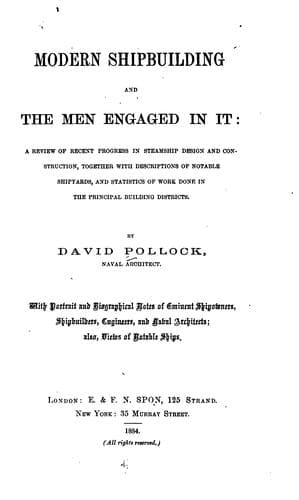
Modern shipbuilding and the men engaged in itPollock, David
History
Modern shipbuilding and the men engaged in it
Pollock, David
Shipbuilding -- Great Britain
After having done its work, the water
is discharged into the return mains, being thus used over and over
again. The experience obtained in the working of the _Quetta_ shows
that a donkey boiler of the usual size, just sufficient for steam
winches, enables the cargo to be discharged in half the time: in
other words, does double the work on a given coal consumpt with
compound surface-condensing pumping engine, and the hydraulic system.
The advantages of hydraulic machinery have been thus summarised:—A
pair of engines in one place do, with no noise and half the
consumption of fuel, the work usually performed by perhaps a dozen
donkey engines, while about £30 or £40 a voyage is saved in wear and
tear. The increase of speed obtained in loading and discharging cargo
practically ensures a quicker voyage. The rapidly working machinery
necessitates double gangs of men in the hold; but though the hands
are more numerous they are paid for a shorter time, and the cost of
labour per ton of cargo is thus less than usual. The prime outlay
is considerably greater than under the ordinary system, but it is
calculated that in at least three years the extra expense will have
been saved.
Notwithstanding the considerable increase in cost (more than double
that of steam equipment) of the hydraulic system, the British India
Association have seen their way to fit the succeeding steamers
they have built, similarly to the _Quetta_, namely, the _Bulimba_,
_Waroonga_, and _Manora_, the two intervening ships having their
emigrant quarters ventilated by fans driven by hydraulic engines, as
well as the usual deck equipment. In addition to the above, there
have already been nine other steamers fitted successfully by Mr
Brown’s firm with hydraulic machinery—including the Union Steamship
Coy.’s _Tartar_, of 4340 tons—and there is every prospect now of its
taking the place of the noisy steam machinery in at least our most
important passenger lines.
* * * * *
Public-domain text, read in full here on John Shaqi.
Reviews
Reviews
No reviews yet
Be the first to share your thoughts on this work.
Elsewhere in the archive
Join the Discussion
Join the discussion
Sign in to leave a comment or review.
Sign InorCreate an account