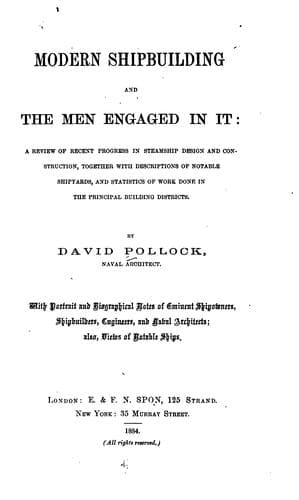
Modern shipbuilding and the men engaged in itPollock, David
History
Modern shipbuilding and the men engaged in it
Pollock, David
Shipbuilding -- Great Britain
Although an influential company was formed to work the _Bessemer_
and other vessels embodying her novel features, which it was thought
might follow, she was virtually abandoned after one or two trials
across the Channel. Her failure was assumed without exhaustive and
conclusive trials being made of the many novelties embodied in
her construction, some of which were obviously of an experimental
character. This is the more to be regretted because of the beneficent
issues involved in the project, and also in some degree because of
the extent to which the faith of some intrepid and experienced men
was pledged to its success. Nevertheless, it was always a matter of
grave doubt, even when the fullest measure of mechanical success was
allowed for, whether the idea of the pivoted saloon was calculated to
secure that immunity from the effects of ship motion in a seaway, for
which the celebrated patentee felt induced to hope.
It is maintained by many who profess to have given the subject
attention, that sea-sickness in its most virulent forms, and in the
majority of instances, is less attributable to the transverse and
longitudinal oscillations—known respectively, as the “rolling” and
“pitching” motions—than to the vertical movement termed “dipping,”
which in its descent from the summit of one wave until upborne by the
wave next following, the vessel undergoes. Now, this is a condition
for which, in the Bessemer project, there was no provision, nor
indeed well can be under any circumstances, save in the simple but
costly expedient of adding to the dimensions or bulk of vessels,
irrespective of form. The Czar of Russia’s yacht _Livadia_, built
some years ago, exemplified in her extraordinary dimensions and great
bulk the truth of such reasoning. The actual rolling and pitching of
this remarkable vessel, as observed in the height of a gale in the
Bay of Biscay, and in the midst of very heavy seas, was exceeding
small. This never exceeded four degrees for the single roll, or seven
degrees for the double roll, nor beyond five degrees for the forward
pitch, or nine degrees for the double pitch, so to speak. This
horizontal steadiness appeared to experts, who were on board at the
time, most remarkable, and Sir E. J. Reed, in a communication to the
_Times_, commented amongst other things on the agreeableness of the
contrast the voyage on the _Livadia_ afforded, with his experience of
voyaging at sea in ordinary ships.
Public-domain text, read in full here on John Shaqi.
Reviews
Reviews
No reviews yet
Be the first to share your thoughts on this work.
Elsewhere in the archive
Join the Discussion
Join the discussion
Sign in to leave a comment or review.
Sign InorCreate an account