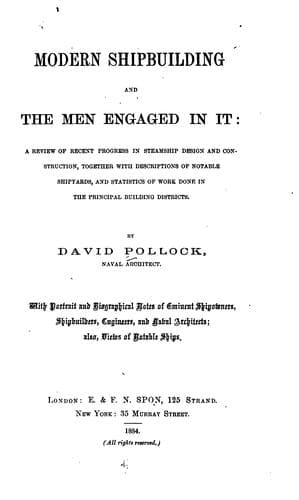
Modern shipbuilding and the men engaged in itPollock, David
History
Modern shipbuilding and the men engaged in it
Pollock, David
Shipbuilding -- Great Britain
“The scheme of the Institution was happily conceived and well
executed. Amongst its earliest members were found the trained naval
architects of the first and second Schools, the leading private
shipbuilders and marine engineers, the principal shipbuilding
officers of the Dockyards, men of science specially interested in
naval architecture, shipowners, merchants, and others connected
with shipping; while a considerable number of sailors from the
Royal Navy and Mercantile Marine showed their appreciation of the
value of naval science by becoming Associates. The list of names
is eminently representative. Sir John Pakington (afterwards Lord
Hampton), then only recently retired from the office of First
Lord of the Admiralty, was the first President. Many experienced
naval officers supported him. There were men like Watts, Read,
and Moorsom, who had been pupils of Dr Inman half a century
before; others, like Fairbairn, Laird, and Grantham, who had been
conversant with iron shipbuilding from its commencement; marine
engineering was worthily represented by veterans like Penn,
Maudslay, and Lloyd; mathematicians and men of science like Canon
Moseley, Dr Woolley, Professor Airy, and Mr Froude appear on the
list. Private shipbuilders and naval architects like Scott Russell,
Samuda, Napier, and White, joined in the movement, so did the
surveying staff of Lloyd’s Register. In fact, there was a general
appreciation of the endeavour to establish an association which
should enable all classes interested in shipping to interchange
ideas and experience with a view to general improvement. Mr Reed
was the first Secretary, retaining that post until he was appointed
Chief Constructor of the Navy, and in that position did much to aid
the progress of the Institution.”
Public-domain text, read in full here on John Shaqi.
Reviews
Reviews
No reviews yet
Be the first to share your thoughts on this work.
Elsewhere in the archive
Join the Discussion
Join the discussion
Sign in to leave a comment or review.
Sign InorCreate an account