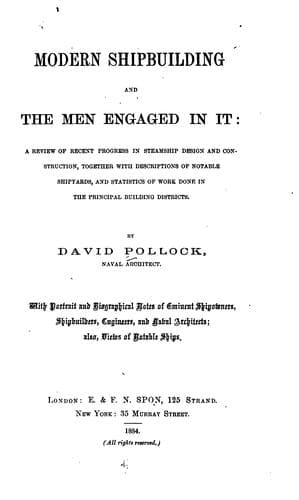
Modern shipbuilding and the men engaged in itPollock, David
History
Modern shipbuilding and the men engaged in it
Pollock, David
Shipbuilding -- Great Britain
Papers; but now everything worth preservation naturally finds
its way to the ‘Transactions.’ Any movement affecting shipping
also leaves its record there in Papers and Discussions which will
hereafter have a high historical value.”
As evidencing the change which has latterly come over the Institution
with respect to its annual proceedings, it may be noted that whereas
in the early years there were at some meetings no papers—leaving out
of account those by Froude and Rankine—except by Admiralty members
and others concerned with Government work, there was not a single
paper by an Admiralty man during the meetings of the present year.
* * * * *
With the general reference already made to Mr Froude’s invaluable
labours in connection with the resistance of vessels the brief
statement of the agencies through which progress has been made during
the present century may be considered as brought down to the period
coming within the scope of the term “Modern,” as used in this work.
The more difficult task of chronicling the progress made during the
period in question, both in the science of naval architecture purely,
and in the application of science to practice, must now be attempted.
The plan upon which it is proposed to accomplish this is to show
wherein and to what extent scientific methods in designing and
observing the behaviour of ships have been regarded, and indicating
generally where still further improvement may be looked for. To
accomplish this in such a way as to take appreciative account of the
most salient features, and yet to avoid difficult technical terms
and unnecessary elaboration, may involve some omissions and slight
inaccuracies, important enough from a strictly scientific point of
view, yet which do not materially affect the faithfulness of the
record.[5]
As preparing the way for references to those more special points in
connection with which scientific progress has taken place during
recent years, the following general and elementary outlines of the
principal scientific problems in ship design and construction may be
helpful to many readers:—
DISPLACEMENT AND CARRYING CAPABILITY.
A vessel floating at rest displaces a volume of water whose weight
equals her own total weight.
For vessels floating in sea water the number of cubic feet of water
displaced per ton of weight is, as nearly as possible, thirty-five.
For vessels in fresh water—_i.e._, lakes or rivers—the cubic feet
per ton of weight is thirty-six.
By calculating the volume of under-water portion of the vessel’s
hull, the number of cubic feet displaced by the vessel when
floating at any given draught is obtained. This result, divided by
35 or 36, according as the water is salt or fresh, gives the number
of tons weight displaced, and consequently the total weight of the
vessel.
Public-domain text, read in full here on John Shaqi.
Reviews
Reviews
No reviews yet
Be the first to share your thoughts on this work.
Elsewhere in the archive
Join the Discussion
Join the discussion
Sign in to leave a comment or review.
Sign InorCreate an account