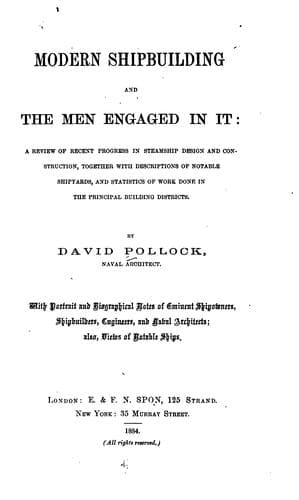
Modern shipbuilding and the men engaged in itPollock, David
History
Modern shipbuilding and the men engaged in it
Pollock, David
Shipbuilding -- Great Britain
To ascertain the accurate maximum strains tending to produce
longitudinal bending, or, in excessive cases, to break the ship
across at the transverse section where the strains reach their
maximum, involves a careful and most laborious consideration of
the relative weight and buoyancy of individual sections throughout
the length, and is a task not generally undertaken in mercantile
shipyards.[8]
References to the nature of the transverse and other strains above
enumerated and the extent to which they have been investigated will
be made further on.
With regard to such fundamental properties of vessels as
displacement, weight, and carrying capability, nothing new has
for a long period been added to the fund of scientific knowledge.
One of the conditions now most commonly laid down by the owners
of a proposed ship is that which provides for a certain carrying
capability on a given draught of water and at a certain speed,
the principal dimensions of the vessel also being stipulated. The
problem of determining what total displacement will be required,
involves consideration and an estimate of—1st, The total weight of
hull having regard to structural strength; 2nd, the total weight of
machinery having regard to speed required. By using “co-efficients”
deduced from the weights of vessels of similar type already built,[9]
these are determined; and adding them to the carrying capability
or dead-weight stipulated, the required displacement can be closely
approximated to. For vessels of abnormal proportions or of very
unusual construction careful and detailed calculations of the weight
of materials are undertaken previous to tendering for them. In some
yards, indeed, a like degree of care is observed in ordinary cases:
methods of approximation involving the use of co-efficients such as
that based on cubic capacity being distrusted.
The further problem of determining what form of hull will give the
required displacement is the essential and all-embracing feature of
the work of design, as it involves consideration of almost all other
properties. The methods of designing ships are various, and a very
common method, at one time more followed than it now is, consists
in shaping a block model direct, and from it taking the necessary
measurements for displacement, and for full-size delineation in
the moulding loft. The disadvantages pertaining to this somewhat
antiquated method are becoming more recognised as shortened and exact
methods of linear or “draught plan” design are put forward.
Public-domain text, read in full here on John Shaqi.
Reviews
Reviews
No reviews yet
Be the first to share your thoughts on this work.
Elsewhere in the archive
Join the Discussion
Join the discussion
Sign in to leave a comment or review.
Sign InorCreate an account