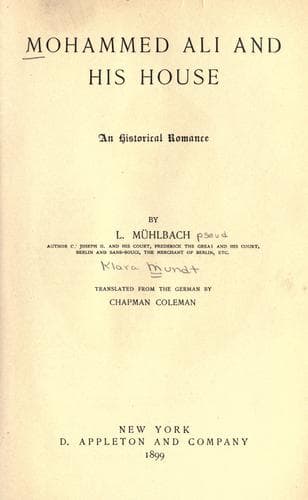
Egypt -- History -- Mohammed Ali, 1805-1849 -- Fiction; Muhammad Ali Basha, Governor of Egypt, 1769-1849 -- Fiction
He turns away as she requested, and gazes in the opposite direction,
at the blue sky and the foaming sea. He sees her not, but the pain
he feels tells him Masa is leaving; he knows, without hearing her
footsteps, that she is walking from him. He remains above as she had
requested. After a while he turns around and looks after her. He
sees the white dove fluttering downward from rock to rock, and at
last disappear on the stairway that leads to Praousta.
"May Allah bless her mission, that I may live, live for Masa, for
her I love so passionately! All that I do shall henceforth be for
her, and Mohammed's life will be bliss and sunshine."
CHAPTER IV.
MASA'S JEWELRY
THE village of Praousta had now assumed a busy look. The men had
assembled around the mosque, and were conversing in eager, anxious
tones.
When they saw the veiled girl approaching they bowed their heads
respectfully, as is becoming in the presence of the unhappy. They
knew the beautiful Masa, in spite of her veil. They knew she had
gone up to her father to implore him to take pity on himself and on
her. They now stepped up to her and asked if her father still lived,
and if there was any hope of preserving his life.
"His life is in your hands," replied Masa. "I come to conjure you to
save the life of my father, and of the noble old men, the ulemas."
"How can we, daughter of Sheik Alepp?" cried the men. "How can we
save their lives?"
"You ask me? Then I will tell you: You must bow your heads beneath
the yoke. You must obey the commands of the tschorbadji."
"Never! never!" cried the men. "Has not the sheik himself forbidden
us to do so? Did not the ulemas, as late as yesterday evening at
sunset, command us in Allah's name to be firm?"
"They did command it," cried the girl, passionately, "and they did
so because they wished to do their duty and obey the law. But it
devolves upon you, ye men, to obey the higher law that dwells in us.
Will you, ye men of Praousta, allow your best and noblest men to be
murdered for the sake of a paltry sum of money. Do you wish that
your children and grandchildren should one day point at you and say:
--Look at them, they are murderers! They slaughtered them that they
might keep their money, that they might keep that which they held
dearest!"
"No, Masa, it is not on account of the money!" cried the men. "It is
a question of our honor, of law, and of justice. And therefore the
sheik has commanded us not to pay. A double tax was imposed on us;
that was unjust. The sheik and the ulemas say that, if we pay this
double tax, they will the next time demand a treble, and the third
time a quadruple tax. In this way they would consume our substance,
and our fate would be poverty and the beggar's staff. Thus spoke the
sheik and the ulemas as late as yesterday evening, and therefore
must we remain firm, and, therefore, oh, forgive us, we should not
dare to pay even if we could."
Public-domain text, read in full here on John Shaqi.
Reviews
Reviews
No reviews yet
Be the first to share your thoughts on this work.
Elsewhere in the archive
Join the Discussion
Join the discussion
Sign in to leave a comment or review.
Sign InorCreate an account