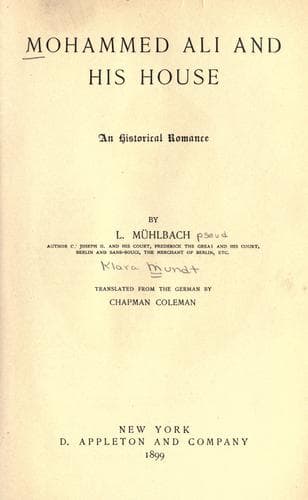
Egypt -- History -- Mohammed Ali, 1805-1849 -- Fiction; Muhammad Ali Basha, Governor of Egypt, 1769-1849 -- Fiction
Her mother had given her, on her death-bed, these, the bridal
ornaments she had brought with her from her father's house, and the
sheik had often remarked that these jewels were worth at least a
hundred sequins.
Until now, their value had been a matter of indifference to her.
What cared she how much money could be had for her pearls and
necklace? She loved this jewelry because it came from her mother,
but now she thinks differently.
"The jewelry is worth at least a hundred sequins, and the tax
certainly does not amount to more. And, if it were more, I should
entreat the governor until he accepted the jewelry as the second
tax. Thus it shall be. O dear mother, look down upon your daughter,
and do not be angry with her for parting with the costly souvenir
given her by you on your death-bed! Do not be angry, and see in it
only love for my father!"
She bowed her head, and kissed the pearls which had once adorned her
mother; kissed the necklace and the tiara that had once shone on her
dear head.
"O mother, I had thought, that on my wedding-day, I too should wear
these costly ornaments. But I know that it will be a matter of
indifference to him, the only one for whom I wish this day to come.
He would not look at the glittering jewels, but only at me. I
therefore willingly part with them; I do not care, for he whom I
love will not be grieved if I come to him unadorned."
A blissful smile overspread her lovely countenance.
She closed and locked the casket, and hid it under her veil. She
hastily walked down the stairway, out of the house, and toward the
mosque, where the men had begun to assemble, each one bringing with
him his proportion of the tax.
"Tell me, ye men," asked Masa, quickly, "what is the amount of the
tax you are called on to pay?"
"The simple tax, Masa, amounts to one hundred sequins. Consider how
heavy a burden this alone is. There are hardly fifty men of us
living here in Praousta, and really it seems to us quite sufficient
that each of us has two sequins to pay at the end of each summer.
But to pay the double tax is simply impossible. Your father well
knew this, Masa, and he therefore sternly commanded us not to pay,
as the demand was contrary to law and justice."
"A hundred sequins," cried she, with sparkling eyes. "Then all is
well. Come, ye men of Praousta let us ascend the stairway. The hour
of the second prayer has not yet come, and until then, with the
tschrobadji's consent, Mohammed Ali has granted us a respite. Wait
on the crest of the rock above until I call you. I shall now go to
the tschorbadji; pray ye, in the mean while, to Allah, that my words
may prove effectual."
She ascended the stairway with flying footsteps. With dejected
looks, the men slowly followed. "We are wrong in allowing her to
persuade us to submit to the tschorbadji. We will, however, pay the
just tax, and no more. We would not pay more, even if we could. Here
let us stay and await the call of our sheik's daughter."
Public-domain text, read in full here on John Shaqi.
Reviews
Reviews
No reviews yet
Be the first to share your thoughts on this work.
Elsewhere in the archive
Join the Discussion
Join the discussion
Sign in to leave a comment or review.
Sign InorCreate an account