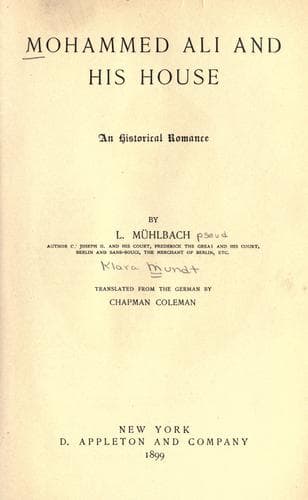
Egypt -- History -- Mohammed Ali, 1805-1849 -- Fiction; Muhammad Ali Basha, Governor of Egypt, 1769-1849 -- Fiction
"Masa" he cries, "it is time to come down to breakfast." He supposes
she is within, in her bedchamber, and has not heard him. "Masa," he
cries again, "come out, my child, come to your father."
All is still as before. He calls for the third time; no one replies.
"Masa, where are you, my child?" The sheik anxiously walks through
the sitting-room to the little chamber where his daughter's bed
stands: no one there either. " Masa, my child, my darling, where are
you?"
He stands still, listening for an answer; he breathes heavily when
as yet no answer comes, but consoles himself with the thought that
she has already gone down, and is awaiting him below, while he is
seeking her in her rooms above.
Hastily, with the quick step of youth, the sheik descends the
stairway again, but Masa was not there. The father's calls grow
louder and more anxious.
"Masa, where are you? My beloved child, come to your father."
All remains still. No answer comes to the father's anxious calls.
The sheik now hurries to the kitchen, where breakfast is being
prepared; Djumeila is standing there at the hearth, perfectly
composed, attending to her cooking. She salutes her master with a
deferential air.
"Where is Masa, my daughter? " cries the sheik.
"I do not know, master," she quietly replies; "I have not yet seen
her today. Early in the morning, before sunrise, I went out to the
meadow to milk the goats, that my child, my darling Masa, might have
fresh sweet milk for her breakfast; since then I have been occupied
with getting breakfast ready, and now you ask me 'Where is Masa?'"
"Spare your words and listen: Masa has vanished; Masa is not in her
room."
Djumeila cries out loudly: "Where is Masa? where is my white dove?"
She rushes out and runs to her mistress's room; and, not finding her
there, falls to weeping and wringing her hands in despair.
"Where is my beloved child? she is not with her father, she is not
in her room." She then hastens to the other maid-servant. "Where is
Masa? has no one seen my master's daughter? has no one seen my
beloved child?"
The sheik stood in the hall and listened to Djumeila's cries and the
answer of the other servant. He then walked rapidly all over the
house again, called his daughter's name loudly once more, and stood
still to listen for an answer.
"But it is foolish to be so anxious. Masa is fond of going out to
the sea to listen to the murmuring and whispering of the waves. My
child is pious, and may have gone to the mosque to pray and to thank
Allah. That is it--she has gone to the mosque."
The sheik rushes out into the street. It is well that the mosque is
not far from his dwelling. The doors are open; Masa is surely there,
probably on her knees in one of the recesses, addressing herself to
her prayers. No, she is not there; the recesses are empty, and she
is not up in the choir with the women either.
"She is nowhere in the mosque; but she may be down on the beach."
Public-domain text, read in full here on John Shaqi.
Reviews
Reviews
No reviews yet
Be the first to share your thoughts on this work.
Elsewhere in the archive
Join the Discussion
Join the discussion
Sign in to leave a comment or review.
Sign InorCreate an account