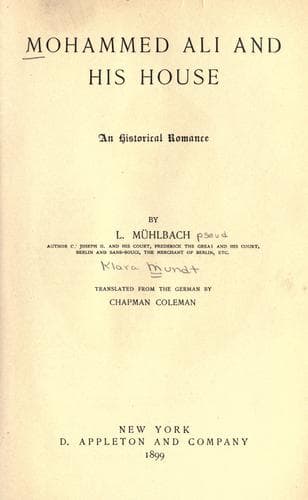
Egypt -- History -- Mohammed Ali, 1805-1849 -- Fiction; Muhammad Ali Basha, Governor of Egypt, 1769-1849 -- Fiction
The tobacco of Macedonia is celebrated far and wide, and vessels
come there from all quarters of the globe to export this article and
distribute it throughout the world. They had, therefore, made
Mohammed proprietor of a large tobacco warehouse, and he had now
been engaged in this business some ten years, and had become a
wealthy merchant. The people called him a happy man, too, and
perhaps be was, for Mohammed seemed to have true domestic happiness
in his wife and children; he conducted no second wife into his
harem. Ada was his only wife, and the sole mistress of his house.
Yes, he was certainly happy in his family; three sons had been born
to him, and he often went out upon the sea with them, and taught
them, in their boats, to command the waves; he also taught them to
handle the gun, and other manly accomplishments. But he never took
the boys to that part of the shore where the entrance to the cave
lay; and the foot of man has never entered it again! The fissure in
the rocks has disappeared, covered with stones.
No one saw Mohammed go to this spot on the evening be fore his
marriage with Ada. No one saw him, as with the strength of a giant
he rolled huge stones to the opening, and piled them up before the
grotto. Nor did any one see him, before he had done this, enter the
grotto with bowed head and folded arms, as though approaching the
holy mosque. Nor did the ear of man hear the groans and lamentations
that escaped his breast as he lay thereon; the spot upon which the
light of the moon and stars of heaven shone down through the opening
above. There he lay, one entire night, and a whole world of
suffering lay on his soul throughout that night. He wished, during
those fearful hours, to rend from his heart the remembrance of all
the anguish and all the bliss associated with that place in the
past. Did he succeed? Who knows, who can tell?
All things pass away, and time heals all wounds.
Mohammed is a wealthy merchant, the husband of a charming, lovely
woman, and the father of three strong, handsome boys, who look out
boldly and defiantly into the world with their dark eyes, the
picture of their father in earlier days.
How would Sitta Khadra rejoice could she see these boys!
Would she also rejoice if she could see her son gravely and silently
attending to his duties, speaking with the men who come to see him,
of tobacco, of good harvests, of future prospects, and of the
success already achieved in his business?
Of other matters Mohammed never speaks, not even to his friend Lion,
who often comes to see him. When Mohammed needs advice at times in
his affairs, he seeks it of him; he listens smilingly when Lion
tells him of what is going on in the world; and, without letting
Mohammed perceive it, attentively observes him, endeavoring to read,
in his grave, tranquil countenance, whether new feelings are
awakening in his soul, whether the young merchant has really buried
the former ambition of the youth.
Public-domain text, read in full here on John Shaqi.
Reviews
Reviews
No reviews yet
Be the first to share your thoughts on this work.
Elsewhere in the archive
Join the Discussion
Join the discussion
Sign in to leave a comment or review.
Sign InorCreate an account