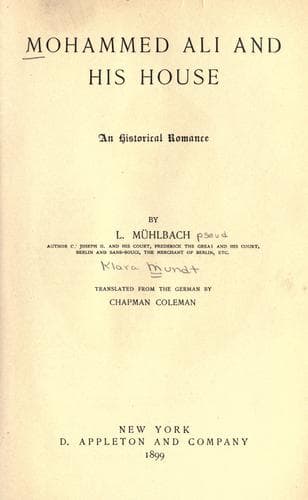
Egypt -- History -- Mohammed Ali, 1805-1849 -- Fiction; Muhammad Ali Basha, Governor of Egypt, 1769-1849 -- Fiction
"You may and you shall," said Osman, and there was a more earnest
and manly ring in his voice than Mohammed had ever before heard. "Do
you not suppose, my boy, my beloved, my second self--do you not
suppose that I read your soul, and know what is smouldering and
lamenting in your inmost heart? Mohammed, I believe you do not wish
to understand yourself. You have enveloped your heart in a veil
which you do not wish to rend asunder, even before your own vision.
But I, my Mohammed, can see through this covering, and know your
heart's most secret thoughts. Be still--say nothing yet. First
consider, and then give me a reply. Your Osman accepts the position,
and it seems to me it would become his friend Mohammed to go with
him where laurels, glory, and magnificence, are awaiting you. Look
at me, my friend; look at the poor, frail body for which you are so
necessary a support, and let us be silent about all the rest for the
present. Yet do not forget that Osman loves you, and is ready to
make any sacrifice for you. Say nothing now, Mohammed, but reflect
on what I have said. And if you love me, and think you owe me your
love, and wish to prove your friendship for me, accept the proffered
position, and go out with me into the world. Go, and reflect about
it, Mohammed, and, when you have decided, come to me with your
answer."
Mohammed left the garden as his friend had asked him, the words "you
must go with me where laurels, glory, and magnificence await you,"
resounding in his heart. He hears them everywhere, at home with his
wife, in the midst of his family. And then the voice of reason would
in its turn make itself heard: "You should not abandon the woman who
rescued you from death, and has given you comfort, wealth, and
position. You should not abandon the children, whom you are called
on to instruct and protect."
"No, I ought not to go," he repeated to himself, as he sat down
beside Ada, and called his children to him. "No, I must remain
here."
And yet, again and again, Osman's words come back to him.
He could not bear to chat with his lips, while such voices were
speaking in his heart. He must leave the house, seek solitude, and
consult with his own thoughts. He made some pretence of pressing
business requiring his attention, and went out into the street. He
started to walk rapidly toward the spot on the rock, where he had so
often sought solitude and consolation. Suddenly he felt a hand laid
on his shoulder, he turned and saw the old Sheik of Praousta, the
successor of Masa's father, who gave him a kindly greeting.
Mohammed always found pleasure with the old man of whom the people
said that he had the gift of prophecy, and could read the future.
Mohammed did not believe in this, but he did believe in his wisdom
and experience of the world; and knew that much was to be learned
from the old man, who had been a great traveller, and had now
returned to his home to rest, to spend the evening of his days as
Sheik of Praousta.
Public-domain text, read in full here on John Shaqi.
Reviews
Reviews
No reviews yet
Be the first to share your thoughts on this work.
Elsewhere in the archive
Join the Discussion
Join the discussion
Sign in to leave a comment or review.
Sign InorCreate an account