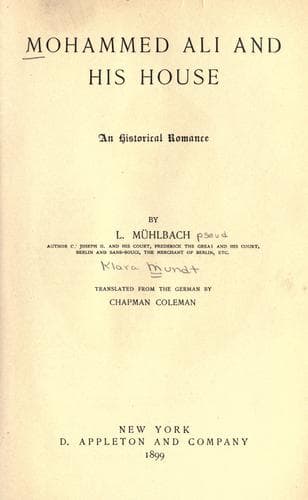
Egypt -- History -- Mohammed Ali, 1805-1849 -- Fiction; Muhammad Ali Basha, Governor of Egypt, 1769-1849 -- Fiction
"But I also have a request to make, my son," said the tschorbadji.
"I have met with an accident: in crossing the court-yard I sprained
my ankle slightly, and I cannot walk, as it pains me. You must
therefore do me the kindness to al low yourself to be carried down
with me in the palanquin. It will excite no surprise; the soldiers
saw me when the accident occurred, and no one will suppose it is on
your account."
"It seems to me, father," replied Osman, gravely, "that the bim
bashi should walk down, and await his soldiers standing."
"And he shall," said his father, quickly. "Below he shall await his
soldiers, standing, while the poor tschorbadji must remain seated in
his palanquin.-Oh, the pain! Let me support myself on your arm,
Mohammed! You have no idea how my foot hurts!"
Osman averted his face, that they might not see the tears that stood
in his eyes. He discerned, only too well, that they both knew his
weakness and were tenderly caring for him!
But, in spirit at least, he must be a man, and he turns and looks at
them firmly and composedly.
"Then come, father. I will go down with you in the palanquin."
The slaves and servants saw the tschorbadji, supported by Mohammed,
limp to the palanquin; Osman followed them with firm footstep, his
head proudly erect. The people rejoiced in his stately appearance,
and in the glittering uniform that became him so well.
Osman was carried down to Praousta at his father's side. The
fishermen, who stood there awaiting him, greeted the young bim bashi
with loud huzzas. They wished him happiness and success in his
military career.
Osman thanked them in a loud, clear voice, and no one knew what pain
the effort cost him. Arrived at the shore, he stepped out of the
palanquin with an appearance of joyous haste, and took up his
position beside his father to receive from the soldiers, who were
now approaching, Mohammed at their head, the military honors. And
now the hour of leave taking had arrived. The admiral's boat had
come to convey the bim bashi to the ship. The tschorbadji insisted
on accompanying his son on board, and seated himself beside him in
the boat into which the slaves and servants who were to go with
Osman now also entered.
Mohammed had declined to go with them to the vessel. The soldiers
must first be embarked, and the boulouk bashi will be the last to
leave the shore, for this the military law requires.
The boats were soon filled with the soldiers, and the bay, covered
with all kinds of skiffs, boats, and barks, now presented a very
gay, lively spectacle. The entire population of Praousta and Cavalla
were assembled on the shore to witness the embarkation.
Ada and her boys had also come down, and were gathered around the
husband and father to take leave of him; beside them stood
Mohammed's old friend, the merchant Lion. As the boats now began to
put off from the shore, Mohammed took his wife's hand and led her
aside, away from the others.
Public-domain text, read in full here on John Shaqi.
Reviews
Reviews
No reviews yet
Be the first to share your thoughts on this work.
Elsewhere in the archive
Join the Discussion
Join the discussion
Sign in to leave a comment or review.
Sign InorCreate an account