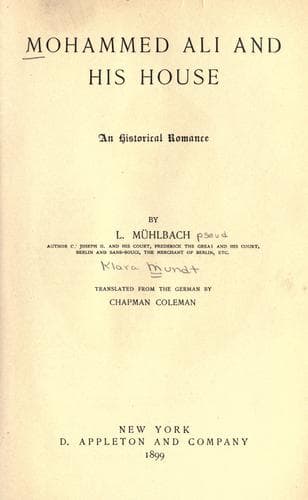
Egypt -- History -- Mohammed Ali, 1805-1849 -- Fiction; Muhammad Ali Basha, Governor of Egypt, 1769-1849 -- Fiction
Sitta Nefysseh has risen from her cushions, but she has not covered
her face with the veil which, fastened to her hair with golden
clasps, falls back over her shoulders. The widow, and above all the
widow of the bey, is allowed to remain unveiled in the presence of a
friend. The great prophet never commanded that the wives of Moslems
should appear veiled in their own houses; the jealousy of their
husbands had gradually imposed this burden upon them. Conscious of
her own worth and dignity, Sitta Nefysseh feels herself free to
disregard such requirement. She turns her lovely countenance with a
gentle smile toward the advancing bey, and Bardissi feels the glance
of her large eyes, though he does not see them. He feels it, and
moves not, a slight tremor possessing itself of his entire being.
What! Bardissi trembles!--the hero, who amid the din of battle
joyously confronts the death-dealing cannon, who never trembles,
though face to face with a whole forest of spears--Bardissi trembles
and turns pale!
Sitta Nefysseh sees it, and her smile brightens. "Why do you
hesitate to approach, Osman? and what have you to say to me, friend
of my husband, Mourad Bey?"
She wishes to remind him that he had been Mourad's friend. He well
understands her meaning, and, stepping quickly forward, falls on his
knee before her, and reverently kisses the hem of her dress.
"I paused, O Sitta, Rose of Cairo--I paused because I heard the song
of the slaves--they are singing my favorite song."
"The song is known to you?" said Sitta Nefysseh.
"It is. Do you know, Sitta, when I first heard this song?"
"I do not," replied she, shaking her head gently.
"May I tell you?"
"Do so; seat yourself on the marble stool standing at the entrance
of the kiosk, and tell me."
She falls back upon her cushion with the easy grace of a swan. But
Bardissi does not take the seat so graciously assigned him. He steps
forward and remains standing in front of Sitta Nefysseh, gazing down
upon her with reverence and delight, as though his glances were a
consecrated gold-inworked veil in which he wishes to envelop her
lovely form, and draw her to his heart.
"Well, Osman Bey, when did you first hear this song?"
He remains silent for a moment; the bees are humming in the air, the
fountains flashing, and from the distance the words of the song the
slaves are singing are wafted over by the gentle breeze:
"Thee alone on earth have I loved. My longing heart is drawn to
thee. And, though this earth were heaven, and it contained my Lubna
not, I'd wander rather through the gates of hell if I but knew my
Lubna there!"
"If I but knew my Lubna there!" repeated Osman Bey, in low,
tremulous tones.--"You wish to know when I first heard this song? I
will tell you. It was on the evening of a bloody day of battle; I
had ridden at the side of our great chieftain, Mourad Bey. He called
me his friend, his--"
Public-domain text, read in full here on John Shaqi.
Reviews
Reviews
No reviews yet
Be the first to share your thoughts on this work.
Elsewhere in the archive
Join the Discussion
Join the discussion
Sign in to leave a comment or review.
Sign InorCreate an account