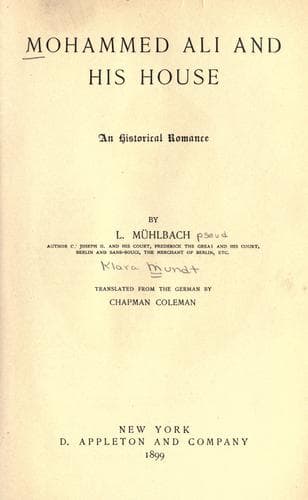
Egypt -- History -- Mohammed Ali, 1805-1849 -- Fiction; Muhammad Ali Basha, Governor of Egypt, 1769-1849 -- Fiction
"I remained standing in the tent and listened to your song, Sitta
Nefysseh. You sang to your husband of love and happiness--sang in
sweet words what Djumeil says to his Lubna: `Nature breathes love.
The bird in the air sings of love; the spring which bubbles at your
feet murmurs of love; the rose that blossoms in the garden sheds
love's fragrance--all is love and bliss. Woe to them who know
nothing more of love, woe to them who bear a cold heart in their
bosom.' This you sang, Sitta Nefysseh, and I stood listening,
entranced. What I then felt was so all-absorbing, so divinely
beautiful, that I was unwilling to have the harmony of that sweet
moment broken in upon by the voice of man. I silently withdrew; your
song informed me that Mourad slept and was in heavenly bliss. I
noiselessly left the tent, and stepped out into the night. The moon
shed its soft light around, enveloping the white tents scattered
over the plain and the terrors of the day in a heavenly, silver
veil.
"I did not return to my tent that night, however. Where was I? If
you should ask, Sitta Nefysseh, I could not tell you. But this much
I can tell you, I was in paradise! I thought of this when I just now
heard your slaves sing the song I then heard for the first time, and
that has resounded in my heart ever since. I covered it with thick
veils, and laid my hand on it to silence it: and I found it possible
to do so while my noble friend Mourad still lived. I forced my heart
to bury in its depths its wishes and longings. I have been silent,
Sitta Nefysseh, not only while Mourad lived, but I have also honored
the period allotted to a widow's mourning. But this is now passed;
pain has vanisbed from your heart, I trust. Your heavenly
countenance is again radiant with youthful loveliness, and no longer
shows the traces of sorrow."
"It is true, Osman Bey," said Nefysseh, with a low sigh; "time heals
all wounds, and sorrow no longer darkens my soul; yet know that
Mourad Bey still lives in my heart, and it is because he still lives
for me that I am able to bear this life and this separation."
"I well know, O Sitta, your fidelity, your noble sentiments,"
replied Bardissi; "it is this knowledge that makes me adore and
reverence you; and were it not strange if I, too, could ever forget
the man who loved you so passionately, and whose memory you still
love? But such love, Sitta, excites no jealousy, and even he who
loves passionately respects such love. Listen to me, Sitta Nefysseh;
hear why I have come to you; I can endure it no longer; the seal
must at last fall from his lips, and Bardissi must give utterance to
what he feels, to that which glows in his heart, and can no longer
be repressed. Yes, Sitta Nefysseh, you must at last hear that I am
dying for love, and that if you refuse to hear me, I must--"
Public-domain text, read in full here on John Shaqi.
Reviews
Reviews
No reviews yet
Be the first to share your thoughts on this work.
Elsewhere in the archive
Join the Discussion
Join the discussion
Sign in to leave a comment or review.
Sign InorCreate an account