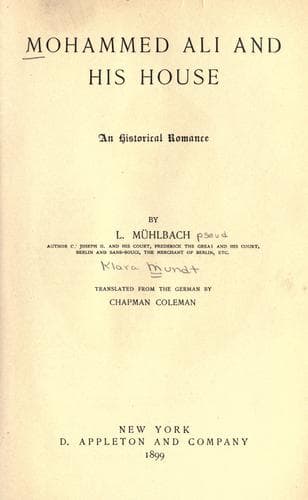
Egypt -- History -- Mohammed Ali, 1805-1849 -- Fiction; Muhammad Ali Basha, Governor of Egypt, 1769-1849 -- Fiction
"I desire nothing more, sarechsme," said she, timidly, "than that
you remain here in the rear apartment of the tent, and I beg you,
should any one come, to remain here quietly; as it is that place
generally reserved for women, no one will dare to enter it. I dwell
in it alone, for my father is not fond of women! He says they are
talkative and quarrelsome, vain and lazy, too, and he has had enough
of them. Twelve wives has he brought to his tent, one after the
other, but after a short time he sent every one of them home to her
father. I am the daughter of his first wife, and my father loves me
more than he has ever loved any of them; and he wants no woman in
his tent but his Butheita. Nor do I wish to have any other woman
here. I can attend to father's household affairs quite well, alone.
I milk the goats, make the butter, and bake the bread. I also spin
the wool of our black sheep, and still have plenty of time left to
knit the shawls my father needs."
"So industrious, Butheita? Happy and enviable will the man be who
shall some day lead your father's daughter to his home!"
"You need not envy him," said she, quickly, "there will be no such
man. It is with me as with my father; he loves only me, and I only
him. No man shall ever lead me to his tent as his wife!"
"Butheita will say that until she loves some man," replied Mohammed,
looking deeply into her eyes. "Would Butheita one day follow me to
my tent--me?"
She did not reply. She drew back in alarm, and again she blushed
deeply, quite unlike a child of the desert, but after the fashion of
a city girl, and drew aside the curtain that divided the tent.
"I am only going to prepare your breakfast."
He did as she had requested, and retired to the second apartment of
the tent, to patiently await Butheita's return. There he sat
absorbed in thought, seemingly forgetful that he was the sarechsme,
Mohammed Ali, and a captive, for a happy smile rested on his lips.
His thoughts were beyond the sea, in the distant Cavalla. Whom did
he see there? It seems to him that Masa, stands before him with her
large soft eyes, and sweet smile; and Masa's image is strangely
interwoven with that of the Bedouin-child, Butheita. The two fair
forms were blended, and it did not displease him. Yet another face
is there. It regards him with a grave yet kindly expression. It is
not the face of a young girl; sweet and youthful fresh ness and love
are not in its features, and yet it is a loved face, that of his
wife Ada, the mother of his children. No, he has not forgotten her!
How could it be possible after living side by side in peace and
harmony for almost ten years! How could it be possible to forget her
who had given him three loved lives? Ah, his beloved boys, how his
heart yearns after them! Yet his heart yearns for her too, for his
wife.
Public-domain text, read in full here on John Shaqi.
Reviews
Reviews
No reviews yet
Be the first to share your thoughts on this work.
Elsewhere in the archive
Join the Discussion
Join the discussion
Sign in to leave a comment or review.
Sign InorCreate an account