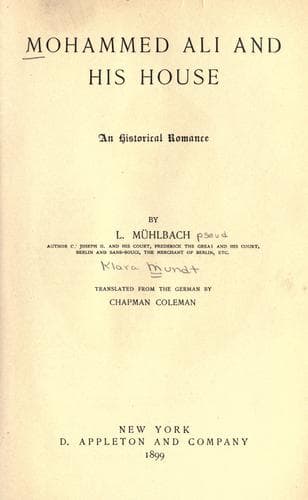
Egypt -- History -- Mohammed Ali, 1805-1849 -- Fiction; Muhammad Ali Basha, Governor of Egypt, 1769-1849 -- Fiction
"Yes, I do," said she. "I have been with father to Tantah several
times. While there I heard the scha-er tell their beautiful stories
of Ey-Zahir. I listened with breathless attention. And then, too, I
heard the female singers, the Gavasi. They sang beautiful songs, and
the words and tones have often since resounded in my heart. Do you
know, sarechsme, that often, when my father had gone out with his
Bedouins to fight or to plunder, as was sometimes the case, then my
only pleasure was to take down the zammarah bisoan, on which my
mother played, and sing to its accompaniment the songs I had learned
from the Gavasi. "Shall I sing them for you? Shall I?" But you must
not laugh at me for repeating what the Gavasi sang in Tantah."
Without awaiting a reply, she took down the little bagpipe with its
bag of goat-skin, and to its shrill accompaniment sang a quaint
love-song with an admixture of the comic.
Her countenance had become grave, and a sweet fire burned in her
eyes, while singing to the monotonous air in a shrill, vibrating
voice, as was customary with the street-singers of the Egyptian
towns. When she had finished her song, she turned the gaze of her
dark eyes upon Mohammed with an inquiring expression. When she saw
the smile on his countenance, and encountered the wondrous glance
that seemed to penetrate to her very soul, she stated. "It pleases
you," said she. "I read in your countenance that you are pleased.
Then I will sing you another song."
She took up her instrument again, and sang, in loud, joyous tones, a
song about a gazelle-like maiden who had run away with her lover's
soul, concluding with,
"Throughout the long, long night his sighing ceases not, his sighing
for the dear gazelle that stole away his soul. Have pity on your
lover; come back to me, gazelle. "
"Gazelle, come back to me! " cried Mohammed, with outstretched arms.
"Gazelle, have pity on your lover."
She seemed not to have heard him, bowed down over her instrument,
and played in such loud, shrill tones, that it almost deafened
Mohammed, who well understood Butheita's motive in playing so.
He smiled at her in silence. Butheita laughed.
"You see my song has gladdened you, and your countentance smiles
again. O joy! See, there in the distance! Yes, there come two
figures. That is my father, that is Sheik Arnhyn. Some one
accompanies him. Rejoice, sarechsme; you will be relieved of your
ennui!"
He laid his band gently on her shoulder, and regarded her with a
long, earnest look, that recalled the roses to her brown cheeks.
"I do not rejoice, Butheita, Queen of the Desert. I have erected a
throne for you in my heart, and my heart spoke to you in the words
of your song--'Throughout the long, long night my sighing ceases
not, my sighing for the dear gazelle that stole away my heart.' Then
speak, gazelle, shall I take you with me? Will you live with me in
the great city? Speak to me, gazelle."
Public-domain text, read in full here on John Shaqi.
Reviews
Reviews
No reviews yet
Be the first to share your thoughts on this work.
Elsewhere in the archive
Join the Discussion
Join the discussion
Sign in to leave a comment or review.
Sign InorCreate an account