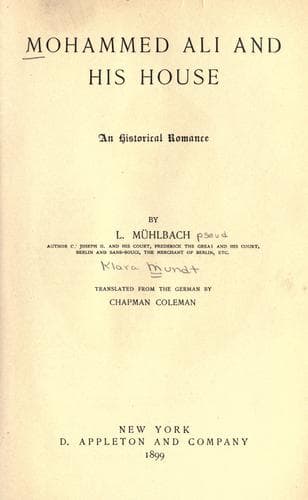
Egypt -- History -- Mohammed Ali, 1805-1849 -- Fiction; Muhammad Ali Basha, Governor of Egypt, 1769-1849 -- Fiction
"And the reason, too, Butheita? " said he, smiling.
"No, sarechsme! I told father I was weary with my long ride. He
loves me dearly, and, although he had intended returning with the
bey to collect the spoils from the field, he is, nevertheless, ready
to accompany you if you will permit him."
"I am to permit you to cause me pain, and deny myself a great
happiness, Butheita. Yet, I understand you, and must say that I
rejoice to see you act as you do. I rejoice in you, my star-eyed
desert queen! Be assured, Mohammed Ali will never forget you. And
now, tell me, will you not quite forget me either?"
"No, that I will not, sarechsme."
"Will you also be mindful of your promise to your father to allow
him only to kiss you, who shall one day lead you to his home?"
"I shall ever be mindful of this promise."
"Then, Butheita, then will I kiss you," cried he, and with
passionate violence he clasped her in his arms, and pressed a kiss
on her lips. He then turned and left the tent.
Butheita sank down upon the mat, and with outstretched arms she
knelt there, motionless, a statue of ecstasy, of blissful love.
Mohammed stepped out before the tent, and beckoned to the sheik to
approach.
"I beg that you will accompany me, sheik; it will be too fatiguing
for your daughter to take this ride the second time."
"Gladly, master; she has already told me so herself, and I am
ready," said he, commanding the dromedary to kneel down. Mohammed
sprang into the palanquin, and the sheik followed him.
"Farewell, Butheita," he cried. She did not answer; she did not wish
to go out, as he might see her tears, and her father, too, might
observe them. She therefore remained silent. She had drawn the
curtain over the entrance to the inner apartment, and lay on the mat
weeping; weeping and laughing at the same time, for joy and pain--
ecstasy and pain were contending for victory in her heart. "He is
gone, gone! and yet he is ever with me."
The dromedary flew over the desert still more swiftly than in the
morning, his feet hardly touching the ground; clouds of sand were
whirled aloft, and enveloped the animal and the riders as with a
thick veil. No one saw them, and, had any one seen them, he could
not have told who they were.
Arrived at the boundary line of the desert, where two horses awaited
them, the sheik halted. Having dismounted with Mohammed, he
addressed a few loud words to the dromedary; it turned, and flew
homeward across the desert.
"It knows the way," said the sheik, smiling. "It will return alone
to Butheita."
They mounted the horses, and rode on swiftly through meadows, and
palm and sycamore groves.
The sheik now drew rein. "Do you see that black line standing out
against the evening sky? That is your camp. If you desire it, I will
accompany you farther. It rests with you to decide."
"I will ride on alone, sheik. Farewell, and accept this for your
hospitality."
He held out to the sheik a purse filled with gold-pieces. The latter
proudly rejected it.
Public-domain text, read in full here on John Shaqi.
Reviews
Reviews
No reviews yet
Be the first to share your thoughts on this work.
Elsewhere in the archive
Join the Discussion
Join the discussion
Sign in to leave a comment or review.
Sign InorCreate an account