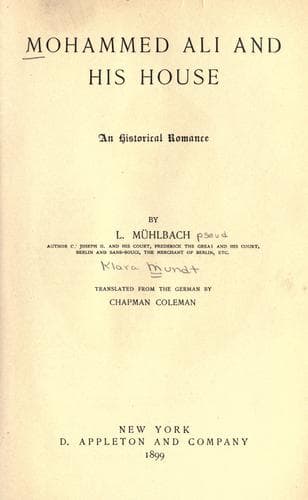
Egypt -- History -- Mohammed Ali, 1805-1849 -- Fiction; Muhammad Ali Basha, Governor of Egypt, 1769-1849 -- Fiction
She drew her veil over her countenance, and slowly left the
apartment. At the door sat her two women weeping and sobbing. She
commanded them to follow her, and walked on as composedly as if she
were the princess of this palace. She swept down the marble stairway
to her carriage, as if about to take a drive.
"Sitta Nefysseh, it will not be necessary to enter your carriage,"
said the cadi, who had followed her. "We shall only have to pass
through that little side-door to be in the sheik's house."
"Ah, you desire to prevent the people, who are calling so loudly
after me, from seeing me in my degradation, or rather the
degradation of those who tread law and propriety under foot in their
treatment of me."
"Sitta Nefysseh, I know nothing of the charges made against you,"
replied the cadi, gruffly. "I obey the orders of the viceroy; the
rest does not concern me."
"That is certainly the most convenient course," said she,
derisively, and quietly submitting when he took hold of her arm and
led her across the court to the little gate in the wall. The women
followed her. Their tears no longer flowed, and they seemed to
consider themselves happy in being at least allowed to accompany
their mistress.
Dense masses of people still stood without. They called loudly for
Sitta Nefysseh, swearing by Allah that they would not leave until
she should be released. But what can the poor, defenceless people do
when confronted by armed soldiers, ready to fire destructive volleys
among them? What can they do but sullenly retire under such
circumstances? This they now did. About the citadel quiet now
reigned, but the streets below were still thronged with dense
crowds, from out whose midst the cries continually resounded: "Sitta
Nefysseh has been arrested! She has been shamefully conducted
through the streets to the citadel by the police! She has been
publicly insulted! She, the noblest of women, is accused of a great
crime!"
When night came, the excitement and fury of the populace had not yet
subsided. Early on the morning of the following day, dense masses of
people surged to the house where Hesseyni, the chief sheik of the
city, resided, and demanded with loud clamors that he should
liberate Sitta Nefysseh.
The sheik had given serious consideration to this difficult and
embarrassing case, and, before the people forced an entrance, had
already determined to comply with their demands.
In solemn procession, their green turbans on their heads, and
enveloped in their long flowing caftans, with their costly ermine
collars, the entire body of sheiks repaired on foot to the palace.
With grave and solemn bearing, these representatives of public
justice demanded that they should be conducted to the viceroy's
presence.
He received them in his apartment, advancing to meet them with a
kindly greeting.
"What do you desire, friends? You know I am always glad to hear the
wishes of the people as pronounced by you, their representatives."
Public-domain text, read in full here on John Shaqi.
Reviews
Reviews
No reviews yet
Be the first to share your thoughts on this work.
Elsewhere in the archive
Join the Discussion
Join the discussion
Sign in to leave a comment or review.
Sign InorCreate an account