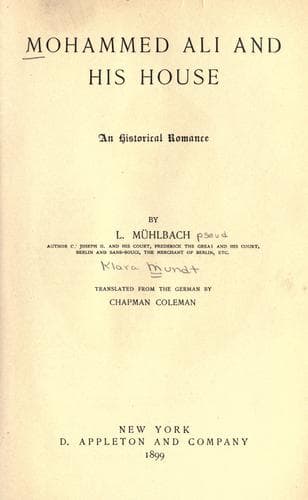
Egypt -- History -- Mohammed Ali, 1805-1849 -- Fiction; Muhammad Ali Basha, Governor of Egypt, 1769-1849 -- Fiction
"I was with his highness, and endeavored to settle this difficulty
without further bloodshed. But he declined, and said there could be
no settlement between you and him except at the cannon's mouth, and
that be would pay you with your own blood!"
The soldiers answered their general's words with a fierce roar; when
this at last subsided, he continued: "The viceroy says the defterdar
is to pay you--that you must look to him. Let us do so, soldiers!
Let us compel him to pay!"
"Yes, be shall pay us!" cried they; and the wild masses again rushed
to the house of the defterdar.
The closed gates are torn asunder; and Taher Pacha's Armenians and
Mohammed Ali's Albanians run with savage cries into the house.
"I have no money!" cries the defterdar, with pale, trembling lips.
"Where are your books, your accounts? We will take you, together
with your books, to our general."
"Do so, do so!" groaned the defterdar, pointing to his books. "Take
me, with my books, to Taher Pacha."
Onward the wild mass surged with their prisoner and his accounts.
They passed the house of Mohammed Ali, who stood at the window, and
looked down at them with a smile of satisfaction.
"The revolt is firmly established; Taher Pacha is at its head, and
we shall see how he conducts the matter."
CHAPTER VIII
THE INSURRECTION.
From the citadel the thunder of the artillery and the fierce shouts
of the people still resounded. Mohammed heard the uproar throughout
the entire night. The soldiers continually pressed forward to
replace their comrades shot down by the murderous volleys from the
fortress.
Mohammed remained quietly in his house. True, his soldiers have
joined the rebels, but who can hold him responsible, and why should
he expose himself to the danger of being refused obedience should he
demand it of them?
Taher Pacha thinks differently. During the night he had examined the
books of the defterdar, held a prisoner in his house, and had been
compelled to admit that he was innocent, and had no money with which
to pay off the soldiers.
On the following morning he announced to his soldiers that the
defterdar was innocent, and the viceroy alone guilty. He had
accumulated and possessed money and treasure, and could pay the
soldiers if he would. He had, however, determined to keep for
himself all the money sent from Stamboul for the troops.
The intelligence rapidly spreads among the soldiers that Cousrouf
has money, and can pay if he will.
"And pay he shall!" cries Taher Pacha. "I will march with you into
his stronghold. Woe to him; he has begun this work of slaughter, and
must take the consequences!"
The gates are closed and barred. What care the soldiers, encouraged
by their general's approach, for that?" The walls can be scaled!" No
sooner said than done. Like cats, the first climb over the high
wall, and the rest follow. The guards within are overpowered, and
the gates are thrown open. And now all rush in intent on victory,
and, above all, on obtaining money.
Public-domain text, read in full here on John Shaqi.
Reviews
Reviews
No reviews yet
Be the first to share your thoughts on this work.
Elsewhere in the archive
Join the Discussion
Join the discussion
Sign in to leave a comment or review.
Sign InorCreate an account