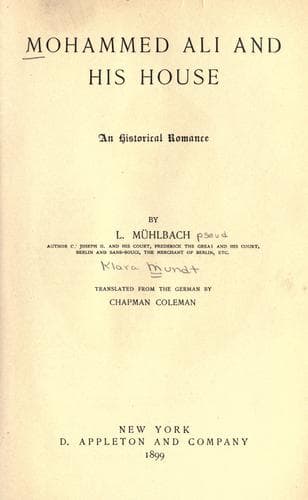
Egypt -- History -- Mohammed Ali, 1805-1849 -- Fiction; Muhammad Ali Basha, Governor of Egypt, 1769-1849 -- Fiction
Bardissi and Mohammed are united in love and friendship, and, though
the former seems to be the ruler, the latter reigns in reality. The
whole city is aware of this, and those who have complaints to make,
and seek redress, come not to Bardissi, but to Mohammed Ali. To him,
also, come the consuls of other countries, of England and France,
and have long and protracted interviews with him.
The object of their meetings is known to no one. Their conferences
are always private, and Bardissi learns of them only what Mohammed
chooses to tell him. "Does he tell him the truth?"
Bardissi is convinced that he does, and also convinced that he and
Mohammed are in perfect accord with each other.
Ismail, the Mameluke chief, is of a different opinion, and often
warns the magnanimous Osman Bey Bardissi.
"Be on your guard against Mohammed Ali; he has evil designs. Be on
your guard!"
Bardissi shakes his head. "Do not attempt to rob me of my friend, my
second self. I love him, and I know that he loves me!"
"He will lead us all to destruction, if he can!" said Ismail,
solemnly. "Mohammed Ali is not the faithful friend you suppose him
to be ! Unfortunately, the future will prove to you that my warning
was well founded."
Bardissi disregards the warning, and angrily affirms Mohammed's
fidelity. He can confide in his friend, and in the wisdom of his
counsel. And, as before, Bardissi continues to follow Mohammed's
advice in all things.
CHAPTER XII
AGAINST THE MAMELUKES.
While the Mameluke beys, Ismail and Bardissi, were victorious at
Cairo, L'Elfi Bey still lay with his followers at Nisibis. There he
ruled, and there his Mamelukes robbed, plundered, and tyrannized
over the inhabitants.
The governor, Courschid Pacha, was again firmly established in
Alexandria, where he was assembling new forces, and preparing to
march against Cairo and the Mamelukes, and also against Mohammed Ali
and his Albanians and Armenians; he only awaited the sultan's
decision. He had sent to Stamboul intelligence of all that had
occurred--of Cousrouf's flight, and of his defeat and capture at
Damietta.
"Who is now to be appointed viceroy?" This was the question to be
decided at Stamboul.
"Do you command, O master, that our troops march against Cairo to
drive out the Mamelukes, and reinstate Cousrouf as viceroy! Command,
O master, and your servants will obey!"
While the Turks were awaiting an answer from Stamboul, affairs in
Cairo were becoming more and more complicated, and law and order no
longer reigned there. The Mamelukes were daily becoming more violent
and overbearing. They roamed through the city in bands, plundering
and burning, and the beys could no longer control them. Daily the
sufferings of the people became greater, and their hatred of the
lawless Mamelukes more intense.
Robbed and outraged as they were, they were, in addition,
continually being called on to pay new taxes to their detested
rulers.
Public-domain text, read in full here on John Shaqi.
Reviews
Reviews
No reviews yet
Be the first to share your thoughts on this work.
Elsewhere in the archive
Join the Discussion
Join the discussion
Sign in to leave a comment or review.
Sign InorCreate an account